With the rapid advancements in AI-driven answers and generative engines, search is no longer just about ranking blue links. Instead, it is about being understood by intelligent systems. This is primarily because of users now being more demanding and expecting instant and context-rich responses rather than endless scrolling. Due to this shift, a discussion has been sparked around GEO vs. SEO. While both practices can help with visibility, they require consistent efforts and take time to show results. As a result, businesses want to prioritize the practice that can provide the best results. If you are also among such businesses, then this article will be of great value, as we will discuss the differences between these two practices to find out which one is best in this AI landscape.
Understanding GEO vs. SEO
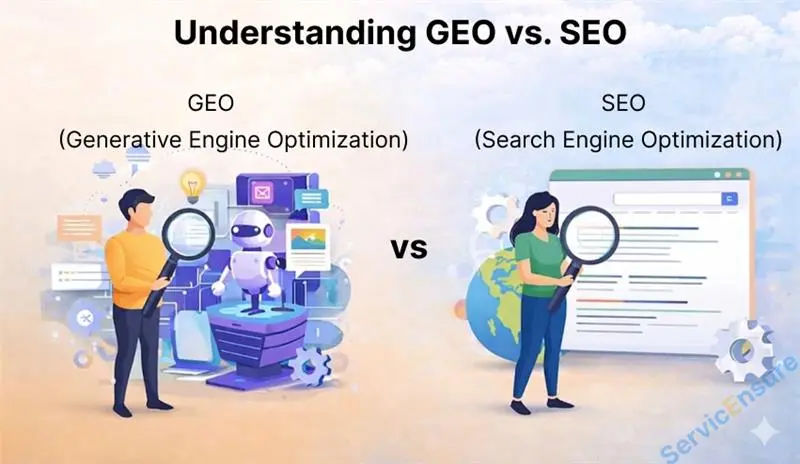
Due to the changes in search behavior, understanding the difference between GEO vs. SEO has become essential for businesses of all scales and niches. Even though both these practices aim to improve visibility, they operate in significantly different ways, not to mention that they also serve different types of search experiences. To help you better understand the distinctions between these two practices, we have shared the process of GEO and SEO below.
SEO
SEO (Search Engine Optimization) is one of the foundational practices of digital marketing and is among the most reliable ones to boost organic visibility on search engines, like Google and Bing. The primary goal of SEO is to make a website rank higher on relevant keywords to attract qualified traffic.
While it is a core digital marketing practice, it has significantly evolved over the years. Once, the practice used to rely heavily on keyword density and building backlinks. Nowadays, however, SEO has become far more sophisticated and user-centric. Due to algorithm updates, like the CORE update, Search engines prioritize relevance, experience, and trust rather than simple keyword matching.
Below, we have shared some of the key elements of SEO.
- Keywords: Although keywords are still important, search engines now prioritize search intent rather than exact matches.
- Backlinks: Also referred to as “vote-of-trust”, they are high-quality and relevant links from other websites and help to boost both trust and authority.
- User Experience: This includes the overall user experience when they visit a website. An optimal user experience can help in improving website visibility.
Due to these advancements, SEO has changed from targeting exact matching phrases to delivering real value to users while meeting technical standards. If you want your business to rank well on organic results, then the most optimal choice would be partnering up with a reliable seo company in Gurgaon.
How SEO Works?
Whether you plan on doing the practice by yourself or by investing in search engine optimization services, you do need to understand how SEO works to ensure optimal results. By combining strategy, execution, and ongoing optimization, SEO can help ensure that your website has a better ranking and performs well. While the practice may look simple at first glance, it actually encompasses three main elements, which are:
- On-Page SEO: This practice includes optimizing titles, meta descriptions, and alt tags, improving content quality and structure, and managing internal links and keyword placement.
- Off-Page SEO: This focuses on building quality backlinks from other related sites to signal trust and authority to search engines.
- Technical SEO: This is the process that focuses on ensuring optimal speed and mobile-friendly design of a website. Moreover, this element is also the one responsible for proper indexing and crawl efficiency.
GEO
Now that you have a good grasp on SEO, let us take a look at the process and importance of GEO. GEO is short for Generative Engine Optimization. This practice involves optimizing the content so it can appear on AI answers rather than organic search results. To help you better understand the differences between GEO vs. SEO, we have shared the key ways in which GEO differs from SEO.
- It provides direct and conversational answers to complex questions rather than just showing links.
- It summarizes information from multiple trusted sources.
- It prioritizes content quality, authority, and clarity over keyword placement.

Why Is GEO Important?
The question of “Why is GEO important?” has been asked many times. To answer this question, we have shared the key reasons below for why GEO matters.
- Provides Direct Answers: GEO does not give the user a page full of links. Instead, it provides direct answers.
- Zero-Click Searches: Due to AI-generated responses, users do not even need to open a single link.
- Brand Visibility Inside AI Content: While GEO provides direct answers, it cites the sources from which it gathered information. This not only helps to build trust and authority, but also contributes to improving visibility.Structured Data: Due to the GEO content structure guidelines, it does not overwhelm the user with information. Instead, it provides clear and well-structured data, ensuring optimal readability.
GEO vs. SEO: Key Differences
Even though the aims of both GEO and SEO are the same, they are fundamentally different from one another. Below, we have shared the key areas in which these practices differ from one another.
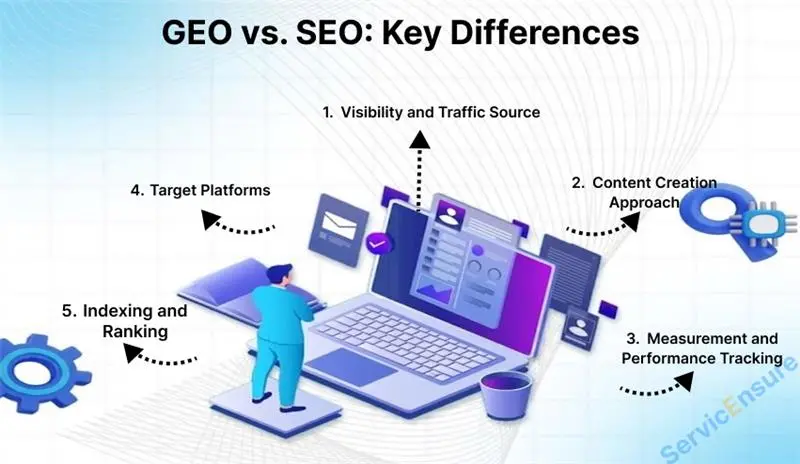
1. Visibility and Traffic Source
The biggest difference between GEO and SEO lies in how visibility is achieved and measured. SEO drives visibility by driving ranking pages on SERPs (Search Engine Result Pages). It builds page-level exposure over time through links and snippets to drive organic clicks from users.
GEO, on the other hand, improves visibility of a website by mentioning its content within AI-generated answers and inclusions in summaries. Although a user may never click on a link in this case, generative engine optimization can help to promote exposure and credibility. This is a result of featuring website content directly in the AI-answers.
2. Content Creation Approach
Both SEO and GEO have significantly different approaches towards content creation. This is because SEO content is traditionally keyword-focused, requires optimization of headings, metadata, and internal linking, while driving specific queries for pages.
As for GEO, it is more intent-focused rather than keyword-specific. Therefore, it requires content to provide clear and direct answers to questions. Moreover, Generative SEO strategies also focus more on precision rather than the length of the content. In comparison, GEO prioritizes clear and authoritative explanations, whereas SEO benefits from comprehensive and long-form content.
3. Measurement and Performance Tracking
The process of tracking performance is also among the major differences between GEO vs. SEO. This is because the metrics of SEO typically includes:
- Keyword rankings.
- Click-through rate (CTR).
- Organic traffic and conversions.
These metrics help you understand how well your website pages are performing on organic results. The performance metrics of GEO, however, are significantly different. This is because it involves monitoring brand mentions in AI responses, visibility within summaries, and perceived authority and topical relevance. Even though GEO lacks standardized reporting tools, its impact is reflected in brand trust, awareness, and influence across AI-driven platforms.
4. Target Platforms
To make your content appear in AI results, you will need to refine and improve it, making the content more precise and clear. Unlike SEO, GEO does not directly target search engines. Instead, it targets AI platforms like ChatGPT, Gemini, and Google AI overviews.
As for SEO, its practices involve making your website more engaging, relevant, and helpful for readers. This results in improving organic visibility on platforms like Google.
5. Indexing and Ranking
Indexing and ranking factors require meeting certain conditions so that the website can rank in search results. Content quality and relevance, proper meta tags, headings, and subheadings are the essential factors for SEO ranking. Moreover, the indexing and ranking factors of SEO are also well-documented. As for GEO, content quality, structure, and clear answers are the main players for indexing and ranking.
Also Read: The Most Important Google Ranking Factors in 2026
Adapt to The Next Era of Search Visibility
As organic searches continue to evolve, the approach for visibility has changed drastically. Due to this, the discussion around GEO vs. SEO highlights a clear shift toward AI-driven discovery while reinforcing the ongoing value of traditional search optimization. However, rather than choosing a single practice, you can combine them to ensure that your business becomes visible to the right audience. With early adaptation, you can also ensure long-term visibility for your business by gaining an upper hand over the competitors.
FAQs
Is SEO still relevant in 2026?
Yes, SEO practices, on-page, off-page, and technical SEO, are still relevant for improving organic visibility and driving traffic.
Will GEO replace SEO?
No, GEO will not replace SEO. On the contrary, GEO practices complement SEO by expanding brand visibility into AI-driven search experiences.
What is the main difference between GEO vs. SEO?
The main difference between GEO vs. SEO lies in how visibility is achieved. SEO focuses on ranking websites in search engine results, while GEO aims to make content visible within AI-generated answers and summaries.
What type of content is best for GEO?
For generative engine optimization, clear, well-structured, and fact-based content performs the best, especially the one that directly answers users’ queries.
How long does it take to see results from GEO?
GEO results vary based on content quality and authority, but consistent optimization can improve AI visibility over time.

Aadiv Atharv is a results-focused Digital Marketing Specialist with expertise in performance marketing, social media strategy, and conversion optimization. He excels at crafting creative, ROI-oriented campaigns that help brands connect with the right audience. His blend of creativity and technical skill makes him a powerful force in today’s competitive digital landscape.