Digital marketing has proven to be the best type of marketing method as it has helped businesses of all scales and niches to reach their targeted audience and grow measurably. While there are a plethora of practices in digital marketing, the debate around SEO vs PPC has been going on for a long time. Although SEO and PPC are reliable practices, they are completely opposites of one another. SEO helps businesses to achieve sustainable results via organic methods. PPC, on the other hand, provides instant results via paid advertising.
Despite their completely opposite natures, many businesses often struggle when it comes to choosing one practice and prioritizing it. If you are also among such businesses, then this article will be highly beneficial to you. In this article, we will thoroughly discuss the differences between SEO and PPC, and will help you conclude which practice is best for your business.
Understanding How SEO Works?
In order to understand how SEO and PPC differ from one another and which one is best for your business, you will first need to understand how exactly they work. To start with, we will look at the process of how SEO works.
As you may already know, SEO stands for Search Engine Optimization, and it is an organic practice to improve a website’s visibility on search results. However, depending on your goals and niche competition, SEO can take a considerable time to show results. The goal of SEO is not to help you achieve quick and short-term results; that is for other practices. Instead, it is to attract consistent and high-quality traffic over time. This can be done by aligning your content with the user’s search intent and following the search engine’s guidelines.
SEO is categorized into multiple components, and below, we have listed the key ones.
- On-Page SEO: This practice focuses on optimizing content, headings, and meta tags to improve readability for both the user as well as the search engine.
- Off-Page SEO: This involves building quality backlinks with other websites to build trust and authority.
- Technical SEO: This practice ensures that your website loads fast, is mobile-friendly, and can easily be crawled and indexed by search engines.
Read: Top 10 Reasons Why Your Business Needs SEO
The Benefits of SEO
Due to SEO being a practice that offers long-term value, partnering with a reliable SEO agency in Gurgaon can be highly beneficial. While the practice of SEO can take a considerable amount of time to show robust results, it nevertheless offers a plethora of benefits. Below, we have listed some key SEO benefits that you can unlock for your business.
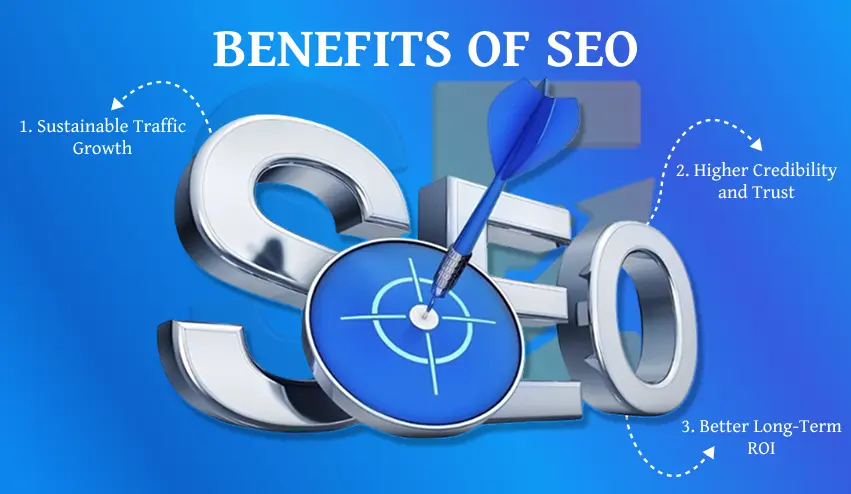
1. Sustainable Traffic Growth
When your site starts to rank on relevant keywords, it will drive regular traffic without requiring you to rely on paid methods. Due to this, SEO practices become a reliable source of attracting the targeted audience over time. Moreover, with proper strategies and implementations, SEO can also help you convert the audience into loyal customers who will keep revisiting your website without requiring any additional marketing methods from your side.
2. Higher Credibility and Trust
Users often only engage with a business that they can trust. By ranking naturally on relevant keywords, you can signal authority, relevance, and expertise for your business. These factors will not only help you attract the targeted audience but will also elevate your rankings on organic results.
3. Better Long-Term ROI
Although SEO is unlikely to show results overnight and may even take months in highly competitive niches, it will give compound results over months and even years. This means that by optimizing your website, you can continuously generate traffic and leads long after your initial effort. As a matter of fact, over 49% of marketers claim that SEO has the best ROI of any marketing channel.
Understanding How PPC Works
Now that we have gone through the process of how does SEO works, let us take a look at how PPC works. PPC is a paid marketing method and stands for Pay-Per-Click. As its name suggests, this marketing method only requires you to pay when a user actually clicks on your ad rather than just viewing it. By running PPC ads, you can gain instant visibility as these ads appear on top of organic results, though they are marked as “sponsored” results.
Similar to SEO, there are also multiple elements in PPC, and below, we have listed the key ones.
- Bidding and Auctions: You need to bid on keywords on which you want your advertisement to appear. Once you have done that, the search engine runs an auction and displays your ad on the sponsored results every time a user searches for the keyword.
- Ad Copy, Landing Page, and Quality Score: A higher bid does not necessarily mean that your ad will appear at the top of the results. This is because factors like ad copy, landing page, and quality score also directly impact your ad position.
- Budget Control and Targeting: While PPC is a paid marketing method, it gives you complete control over your budget. Moreover, you also get the same flexibility in the targeting options.
Although PPC can provide results almost instantly, they are often short-term, such as signing up for a newsletter and selling products quickly. In order to ensure that your advertisements get the best results, we recommend that you partner with a reliable PPC company in Gurgaon.
The Benefits of PPC
Whether you are running a small-scale business or an already established organization, PPC advertisements can help you quickly achieve the desired results. To help you better understand what this practice has to offer, let us take a closer look at the key PPC benefits you can avail for your business.
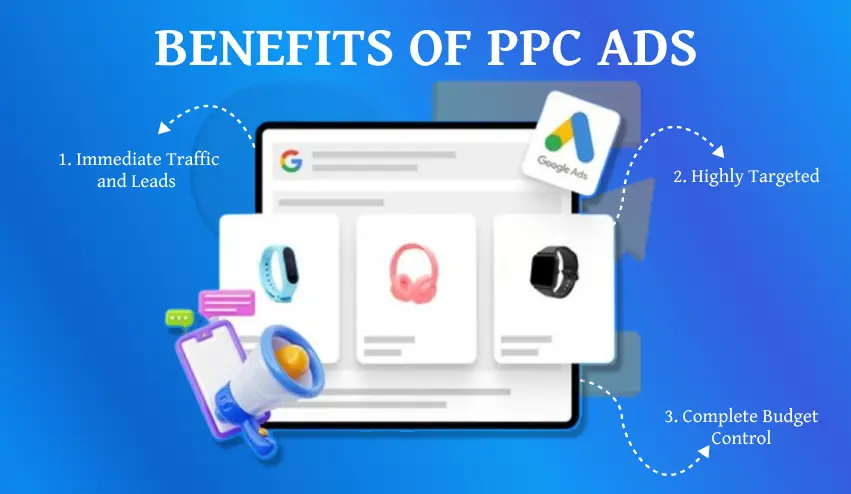
1. Immediate Traffic and Leads
By running PPC ads, you can gain instant visibility at the top of search results. This can help you instantly generate leads without waiting for an improved ranking. Due to these PPC benefits, the practice becomes especially ideal when you want to quickly sell your products or services without spending an abundance of time competing with your rivals.
2. Highly Targeted
In PPC, instead of targeting broad audiences, you can be highly specific. You can target the users based on their demographics, interests, behavior, and device. This can help you ensure that your ads are reaching the most relevant group of audiences. Furthermore, you can also create multiple audience segments and use them for your future advertisements.
3. Complete Budget Control
In PPC ads, you can choose between a daily and a monthly budget and can even adjust your spending at any time. As a result of this freedom, you will be able to push budget on high-performing campaigns and halt the ones that are not bringing any results.
Read: What Is PPC Advertising And Why Businesses Need It?
The Difference Between SEO and PPC
While both SEO and PPC are core practices of digital marketing, they are completely different from one another. Therefore, you need to understand what the exact factors are that set these practices apart, so that you can choose the best one for your business. To help you effectively overcome this hurdle, we have shared a detailed distinction between SEO vs PPC below.
1. Cost Structure
SEO is a long-term investment, and the cost associated with it is usually for content creation, technical optimization, and ongoing improvements. Once your website starts to appear on organic search results, traffic will start to flow without requiring any further investment. PPC, on the other hand, is a paid method and requires continuous spending.
2. Time to Results
In terms of the difference between SEO and PPC for time to see results, PPC stands as the clear winner. While SEO can also provide robust results, it can take a considerable amount of time to show them. PPC, however, can provide results almost instantly.
3. Sustainability
The key difference between SEO and PPC is that SEO supports long-term growth, while PPC assists in achieving short-term results. Due to this, SEO becomes the better choice if you want to unlock sustainable growth for your business.
4. Trust and Credibility
SEO can help build trust and credibility in the long run to build trust and credibility. This can result in signaling search engines and users that your website is credible and trustworthy. PPC, on the other hand, is clearly labeled as sponsored. This factor plays a major role in SEO vs PPC for business decisions.
5. Scalability
PPC is easier to scale quickly by increasing budgets and expanding targeting. SEO scalability requires more time, content, and authority building but delivers stronger long-term returns.
Below, we have shared an SEO vs PPC comparison table to help you better understand the difference between these practices.
| Factors | SEO | PPC |
| Cost Structure | Investment-based | Pay-per-click |
| Time to Results | 3–6 months | Immediate |
| Sustainability | Long-term | Short-term |
| Trust & Credibility | High | Lower (ads labeled) |
| Scalability | Gradual | Instant |
| ROI Over Time | Compounding | Stops when the budget stops |
Contact us today and get a free marketing plan for your business.
SEO vs PPC By Business Type
Despite SEO and PPC being among the core practices of digital marketing, there are significant differences between them. Although we have covered the key differences above, you also need to understand which practice is best for which business type. Therefore, we have shared the key differences between SEO vs PPC for business types.
- Startups: If you are a startup owner, then your primary goal should be to build sustainability over instant results. Due to this, you should prioritize SEO, while using PPC only for traction.
- Small Businesses: Like startups, the concept of SEO vs PPC by business type is also similar for small businesses. SEO can help create a stable foundation for business growth, while PPC can provide the much-needed visibility.
- Ecommerce: Ecommerce businesses are all about selling products. Therefore, investing in PPC is the most optimal choice. However, you can also use SEO if you want to establish category dominance in the market.
- B2B Services: SEO can help build long-term authority and trust through informative content. PPC, on the other hand, can help attract high-intent users quickly. This can help to generate quality leads, all the while supporting consistent business growth.
Make The Smart Choice Between SEO and PPC
Choosing SEO vs PPC ultimately comes down to your business goals, budget, and timeline. Both strategies play a vital role in digital marketing and can deliver strong results when used correctly. SEO focuses on building long-term visibility and trust, while PPC helps businesses gain immediate exposure and quick wins. By aligning your strategy with your objectives and investing wisely, you can ensure consistent growth, better reach, and sustainable online success.
FAQs
When to choose SEO vs PPC?
Choose SEO if you want long-term growth for your business. However, if you want quick results for your business, then PPC is the way to go.
Can I use both SEO and PPC together?
Yes, using both these practices simultaneously is an excellent choice. SEO can help you improve organic visibility naturally, while PPC will drive leads instantly. However, doing so will require you to double your investment in both time and effort.
Is PPC good for small businesses?
Yes, PPC is an excellent paid advertising method for small businesses, as it can instantly drive potential leads without requiring them to compete with big names organically.
What happens when I stop running PPC ads?
When you stop running PPC ads, your advertisements will no longer appear in search results. As a result of this, you will not be able to continuously drive traffic to your website.
Can SEO and PPC target the same keywords?
While SEO and PPC can target the same keywords, the keywords for PPC are usually of high intent. Keywords of SEO, on the other hand, can be informational and long-tail.

Ved is a skilled Digital Marketing Expert known for building data-driven strategies that boost brand visibility and lead generation. With hands-on experience in SEO, PPC, and content marketing, he helps businesses scale their online presence and achieve measurable growth. His analytical approach and constant learning mindset make him a go-to expert for modern marketing challenges.