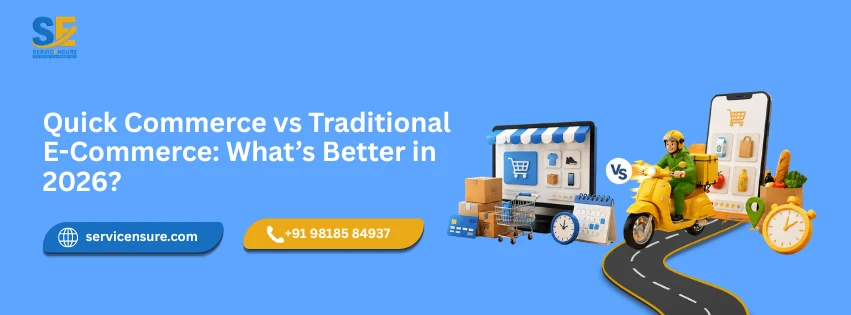
There have been changes in the sphere of digital commerce, and companies are now required to adapt to the new trends. Currently, one of the most prominent discussions is Quick Commerce vs Traditional E-Commerce. In light of the growing popularity of instant delivery services and changes in the consumers’ purchasing behavior, it is vital to comprehend the distinction between them.
Having knowledge on Quick Commerce Vs Traditional E-Commerce is crucial for companies looking to expand their presence in the online market. Be it a new company or an existing one, choosing the appropriate model will help you achieve your goals.
In this blog post, we will cover the differences between these two models, look at the advantages of Quick Commerce, analyze the current trends in Quick Commerce, and answer questions such as Why is e-commerce important today and Is e-commerce profitable in 2026?
What Is Traditional E-Commerce?
Traditional e-commerce is the most common approach to conducting business through the internet. Shoppers access a website or application, search through the products, make purchases, and have their orders delivered in three to four days.
Characteristics of Conventional E-commerce include:
- Variety of products available
- Competitive prices
- Orders delivered in one to five days
- Warehouse space for storing goods
- Able to reach a nationwide and even worldwide customer base
Companies rely heavily on e-commerce development services that create an effective and user-friendly platform for all of their needs such as displaying items, processing payments, and managing orders.
What Is Quick Commerce?
To understand Quick commerce vs Tradional E-commerce it is necessary to understand each one of them one by one. Quick commerce or Q-commerce is all about delivering goods within 10 to 30 minutes. This type of commerce is meant for consumers who need everything immediately.
The conventional warehouse model has been replaced by the dark store model. The dark stores are strategically placed near the consumer to enable fast delivery.
Important Characteristics:
- Speedy delivery
- Fewer choices of products
- Basic necessities are targeted
- Local operations
- Convenience-oriented
Quick Commerce Vs Traditional E-Commerce: Key Differences
Here is a quick comparison to help you understand both the models easily.
| Feature | Quick commerce | Traditional E-commerce |
| Delivery time | 10-30 min | 1-5 days |
| Product range | Limited time | Wide |
| Pricing | Slightly higher | Competitive |
| Inventory | Local dark stores | Large warehouse |
| Customer intent | Urgent needs | Planned purchases |
| Reach | Local | National /Global |
Real-World Examples: Who Is Winning Where
Quick Commerce Companies
- Blinkit: Blinkit is an application that utilizes the quick-commerce model that involves using dark stores and data analytics to deliver groceries, essentials, and electronics within 10-13 minutes.
- Zepto: A top Indian quick commerce app that provides fast delivery of groceries, vegetables, dairy products, and daily essentials in just 10 minutes using its dark stores network to deliver the goods immediately. Its focus is on high-frequency, small-basket purchases in large metropolitan cities.
Traditional E-Commerce Leaders
- Amazon: Amazon is primarily used as an e-commerce marketplace for buying and selling a wide variety of items, ranging from electronics and clothing to groceries.
- Flipkart: Flipkart is a prominent e-commerce marketplace in India for purchasing/selling a wide variety of items, ranging from electronics to clothes and even groceries
Insight:
These models are not rivals, but they have different purposes.
Also Read: What is Social Commerce, Tips and Trends in 2026
Understanding Change In Consumer Behavior
To better understand this change among Quick Commerce vs Traditonal E-commerce. it is necessary to examine why consumers prefer one to the other.
Quick Commerce Consumer Behavior
1. Trend towards instant gratification
2. Preference for convenience over price sensitivity
3. High expectation for reliability and transparency
4. Convenience-based
E-Commerce Consumer Behavior
1. “I will research and shop.”
2. Higher basket size
3. Price sensitive
4. Research-based
Benefits Of Quick Commerce
Quick commerce has gained popularity due to a number of reasons. Let us look at some key advantages of quick commerce:
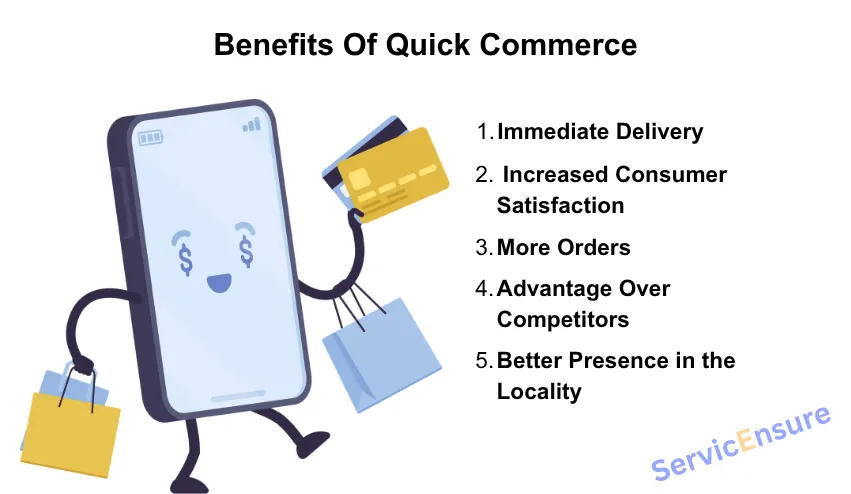
1. Immediate Delivery: Consumers receive goods almost instantly, which works well in cases of emergencies.
2. Increased Consumer Satisfaction: Quick service ensures that the experience is good overall.
3. More Orders: Individuals tend to place orders more frequently due to convenience.
4. Advantage Over Competitors: Organizations offering fast deliveries may gain an advantage over their competitors.
5. Better Presence in the Locality: Quick commerce allows organizations to relate better with their local customers.
Quick Commerce Trends In 2026
The future for quick commerce seems promising. Some of the major trends in quick commerce are as follows:
1. Entry into new categories: Quick commerce is not limited to groceries but includes electronics, fashion accessories, and others.
2. AI and automation: AI and automation are used to predict demand and optimize delivery.
3. Expansion to smaller cities: Quick commerce is spreading to Tier-2 and Tier-3 cities in India.
4. Environment-friendly deliveries: The use of electric vehicles and sustainable packaging is becoming common.
5. Mobility and voice integration: Orders can be placed via mobile applications and voice assistants.
Why Is E-Commerce Important Nowadays?
For those who are curious about the significance of e-commerce, the following are some vital points:
1. Convenience: You can shop anytime and anywhere.
2. Larger Audience: Business enterprises have a broader reach since they are not restricted by geographic locations.
3. Economical Operations: Operating online shops is cheaper than operating physical shops.
4. Analyzing Customer Behavior: Businesses can analyze customers’ shopping behaviors and refine their strategies accordingly.
5. Rising Digital Literacy: Smartphones and internet usage among consumers have been rising in recent times.
With the assistance of competent e-commerce web development company in Gurgaon, business firms can develop robust systems that satisfy customer expectations.
Is E-Commerce Worth It In 2026?
Yes, here’s why:
- E-commerce keeps on booming
- Internet-based payment systems are common
- Efficient logistics networks are being established
- Convenience is what consumers want
Small business owners should not overlook this trend either. By investing in e-commerce website design services, your business can flourish.
Also Read: SEO for E-commerce Website: Rank Your Online Store on Google
What Is The Future Of E-Commerce In India?
The future outlook of e-commerce in India looks very bright. This is due to the following reasons:
1. Increasing Number of Internet Users: There is an increasing number of affordable internet users.
2. Increasing Number of Smartphones: Mobile shopping is likely to become the most convenient means of shopping.
3. Increasing Trend of Quick Commerce: Increasing number of investments in quick commerce.
4. Favorable Government Policies: Digital policies are promoting digital business in India.
In the coming years, quick commerce and e-commerce will develop hand in hand and cater to the diverse needs of consumers.

Role Of E-Commerce Web Development Services
Regardless of the option that you select, a robust website remains key.
- E-commerce website development services enable you to:
- Design efficient websites
- Implement safe payment solutions
- Enhance user experience
- Handle inventories and orders
- Increase SEO results
Selecting the appropriate e-commerce website development agency guarantees future success.
Get in contact with the experts at ServicEnsure today and book your free consultancy call now.
Conclusion: choose the best for your business
There is no question of one being superior over the other when it comes to discussing Quick Commerce Vs Traditional E-commerce; rather, it is a matter of which is appropriate to suit your company’s needs.
Quick commerce is revolutionizing shopping due to its speed and convenience while traditional e-commerce maintains its versatility and scalability. As you will progress with ServicEnsure digital marketing agency, those who manage to utilize both concepts and choose quality e-commerce web development services shall thrive.
FAQs
What is the difference between Quick commerce vs Traditional E-commerce?
Quick commerce is about speedy delivery (usually between 10-30 minutes), whereas Traditional e-commerce involves slower delivery time (1 to 7 days). Convenience is what quick commerce values, while conventional e-commerce is more concerned with diversity and affordability.
What are the benefits of quick commerce?
Benefits of quick commerce:
Efficient inventory control using dark stores
Immediate delivery
Enhanced convenience for essential items
Customer satisfaction
Is E-commerce still relevant in 2026?
Indeed, e-commerce is still relevant in 2026. Even though quick commerce is rapidly expanding, e-commerce is still the reigning champion in product categories such as electronics, clothing, and bulk purchases.
What are the latest quick commerce trends?
The major trends in quick commerce include:
Mobile application integration for efficient ordering
Dark store expansion
AI-powered inventory control systems
Hyper-local delivery services
Why is e-commerce important nowadays?
E-commerce plays a vital role since it:
Is cost-effective than brick-and-mortar stores
Allows businesses to operate on an international scale
Provides customer convenience
Fosters digitalization

Ved is a skilled Digital Marketing Expert known for building data-driven strategies that boost brand visibility and lead generation. With hands-on experience in SEO, PPC, and content marketing, he helps businesses scale their online presence and achieve measurable growth. His analytical approach and constant learning mindset make him a go-to expert for modern marketing challenges.