SEO for e-commerce website is a crucial aspect especially when you are running an online store. It is the process of optimizing an online store so that it appears higher in search engine results. Making it easier for the customers to know about your products and services. But if you are just starting your business or new to the field of SEO, then it might be complicated to understand what is SEO for E-commerce and how it works.
In this digitally competitive landscape the success of E-commerce websites hinges on one crucial factor—visibility. If your website is not ranking high on search engines then probabilities of driving sales and valuable traffic are very low. No matter how great your products are, if the customers can not find you, they will not buy from you.
This guide will walk you through everything you need to know, whether you are running a shopify store, a Woocommerce website, or a custom built E-commerce solution. Here you will be able to understand what you need to build a strong E-commerce website.
What is e-commerce SEO?
If your website has great products but no rankings, then buyers will not be able to locate your site online, this is where SEO for e-commerce comes in. Unlike paid ads that will fall apart once your budget runs out, SEO is a long term strategy that drives organic traffic over time. Organic traffic is more likely to convert as it often comes in the form of people who are genuinely interested in the products and services you offer.
E-commerce SEO is the process of improving an online store’s organic rankings in search engines such as google and bing. By using various e-commerce SEO best practices, such as keyword research, optimizing products for target keywords, link building, and creating a quality content chances are your website will rank higher and drive more potential customers.
Why SEO Is Important for E-commerce Websites
SEO is important for E-commerce websites because it helps them get more traffic and drives sales. Here are some of the major benefits of e-commerce SEO and why it is important:
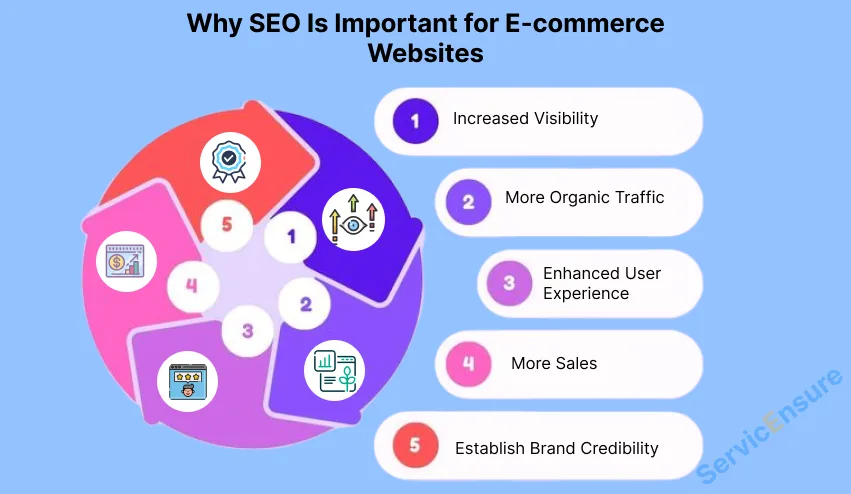
- Increased Visibility: optimizing your online store by implementing proper SEO strategies will allow search engines to make your site appear on top of the search results. This is the core aim of any online business. It is seen that the majority of users click on those sites that appear on one of the top 5 results on search engines. Hence making visibility an important factor in determining the success of your online business.
- More Organic Traffic: SEO also ensures that your website gains more organic traffic, which means attracting only those customers who are genuinely interested in your products and are more likely to convert. Unlike paid traffic, organic traffic does not need constant ad spend. Investing in SEO might feel overwhelming, but it pays off in the long run.
- Enhanced User Experience: with the ever changing algorithms of search engines, websites that offer excellent user experience, less loading times, mobile friendliness and secure browsing are favoured by search engines. By optimizing your website for these factors, you can increase the overall user experience, leading to higher conversions.
- More Sales: the higher your website appears on the search engines the more customers will be able to find it. When you combine visibility with compelling product description, quality images and easy to navigate website, the results will eventually be more customers and sales.
- Establish Brand Credibility: higher rankings on search engines makes your website look more credible. People trust those websites that position themselves at the top of the search results page. This in return will set you as an industry leader.
SEO can seem a bit challenging and ever-changing, rather than feeling overwhelmed, try leveraging ServicEnsure digital marketing agency, that can handle all your online marketing needs. While SEO for E-commerce websites can build long term viability, working with a reliable agency can accelerate your growth across multiple conversion-focused channels.
Also Read: Top Benefits of Hiring an SEO Agency For Smarter Marketing
E-commerce SEO vs Traditional SEO: Key Differences
Search engine optimization is crucial for any type of website, be it traditional or normal. Both of them can produce a steady flow of website traffic without requiring payment for each click, if used in a correct way. However, the objectives and approaches to each one of them vary greatly. Hence, businesses need to understand the basic difference between E-commerce SEO and normal SEO.
| Aspect | E-commerce SEO | Normal SEO |
| Primary goal | Direct sales, revenue and conversions | Brand awareness, traffic and lead generation |
| Site structure | Hierarchical, deep with categories and information | Simple,focus on blogs, services and company pages |
| Content | Includes product descriptions, company pages and buying guides | Includes articles, blog posts and educational guides |
| Key metrics (KPIs) | Conversion rate, revenue, cart abandonment rate | Traffic volume, time on pages, bounce rates |

The Ultimate Ecommerce SEO Checklist To Drive More Traffic And Sales
Whether you are launching a new online store or want to expand the existing one, this ecommerce SEO checklist will help you guide long term growth and drive more traffic.
- Conduct In Depth Keyword Research
A proper keyword research serves as a basis for any successful business, keywords not only brings traffic to your websites but also targets the shoppers who are ready to make a purchase. Conducting a proper keyword strategy will help you align your business with the target audience.
Pro tip: leverage long tail keywords, use of on page SEO analysis tools, make a proper sitemap for products, categories and blog pages.
- Customize Your Site Structure For SEO
A proper structured content improves both user experience and SEO. With the increase of AI overviews, search engines are prioritizing contents that give direct and logical answers. Use flat architecture for your content, where major pages should be available within three clicks, also avoid the deep nest of categories that might confuse users and search engines.
- Ensure That Your Ecommerce Website Is Mobile Friendly
Google and other search engines prioritize the mobile version of your website. A seamless, intuitive mobile experience of your site will lower bounce rates and boost mobile conversions.
- Create High Quality SEO Friendly Content
This is the major checklist you should not avoid. Understanding the different types of SEO content, from blogs to landing pages will help you expand your strategy and reach users at various stages of the buying journey.
- Improve page load speed for better experience
If your website is taking a long time to load then chances of bounce rates will be higher. Google also uses load time as a ranking factor, majorly on mobile devices. Improving the speed of your website not only improves the user experience but also ensures that search engines can efficiently crawl and index all your important pages.
- Build High Quality Backlinks
If you are unaware about where to start with the link building, then you can explore the best off-page SEO tools such as: Ahrefs and Semrush, which will help you identify the link opportunities, monitor backlinks and analyze your competitors. Focus on a trusted Off-page SEO strategy to ensure that link building is done ethically and strategically.
- Optimize Product Pages
Optimize the product pages by crafting unique key-word rich titles and descriptions. Key steps include improving page speed, ensuring mobile friendliness, adding customer reviews for user-generated content and using clear CTA buttons.
Future of E-commerce SEO
The future of e-commerce SEO is shifting rapidly from keyword-focused rankings towards AI driven, semantic and highly visual experiences.
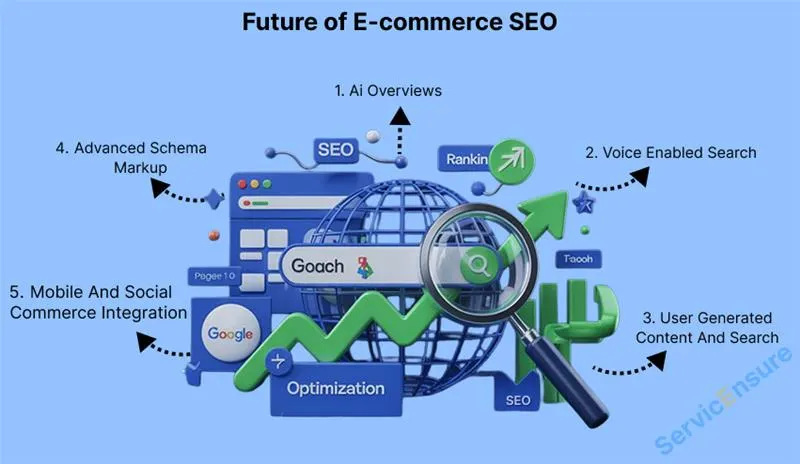
Key future trends in E-commerce SEO includes:
- Ai Overviews
As AI driven search summaries become standard, search engines are now prioritizing contents that deliver direct answers. AI overviews are now the mainstream resulting in the shift of SEO towards optimizing for large language models rather than just traditional search models.
- Voice Enabled Search
With over 50% of the searches are now expected to be voice based, optimizing for long tail, natural language, and question-based phrases is essential.
- User Generated Content And Search
Search engines are prioritizing authentic, user generated content like reviews, testimonials and community discussions over AI generated filters.
- Advanced Schema Markup
Advanced schema markup is essential for E-commerce SEO, as it translates product data into machine readable code significantly improving search visibility and increasing click through rates via rich snippets.
- Mobile And Social Commerce Integration
Seamless, app-like mobile experiences and purchasing directly through social media platforms (Instagram, TikTok) are critical for visibility.
By aligning your strategy with these emerging trends, you can safeguard not only your immediate success but enduring relevance in an ever evolving market.
Relying on the best SEO company for e-commerce business will help your business make the best SEO strategies that will further enhance visibility, improve user experience and increase conversions.
Measuring E-commerce SEO Performance
It is very important to measure the success of your E-commerce SEO, specifically if you have not established any goals before the campaign started.
There are a number of things to look at measuring the success of your SEO campaign. To make informed decisions, you must be armed with data, which can be achieved by connecting your website with an analytics software. Google analytics is the most popular analytics software for websites.
Deeply identify your SEO goals especially if you are about to start the company or even expanding the existing one, it is of no use if you are unaware of the idea of where to begin. Also identifying the preexisting mistakes in your website provide you with a high level of overview of what you would be up against.
Platform Specific Ecommerce SEO
Shopify SEO
Shopify is the most common E-commerce platform and it handles many SEO fundamentals such as: automatic sitemap generation, mobile responsiveness, canonical tags on collection pages. However, it has some notable limitations.
- Blog functionality is basic, consider whether shopify’s native blog is sufficient or whether a headless CMS integration makes sense for content-heavy strategies
- Duplicate contents between products requires careful canonical tag management
- App overload is the common problem, each installed app adds javascript to your pages, which compounds load times issues.
Woocommerce SEO
WooCommerce on WordPress gives you the most SEO flexibility of any major ecommerce platform, primarily because WordPress’s SEO ecosystem is the most mature available. Yoast SEO and Rank Math both have WooCommerce-specific features that handle most on-page optimization needs. Key considerations are:
- Woocommerce urls are highly customizable, set these up correctly from the start of launch because changing URL structure later requires redirects at sales.
- WordPress hosting quality varies enormously– WooCommerce stores on cheap shared hosting often have critical speed problems that undermine SEO performance
- The flexibility of WordPress means technical SEO issues can accumulate quickly if theme and plugin choices are not managed carefully.
Magento SEO
Magento is built for enterprise-scale catalogs and has robust built-in SEO features, but its complexity means technical SEO issues at the Magento level are typically handled by specialist developers rather than marketing teams. Key areas to monitor include canonical tag implementation across large catalogs, layered navigation (Magento’s faceted navigation system) configuration, and server-level performance optimization.
Common E-commerce SEO Mistakes
These are some of the most common SEO mistakes that can hinder the growth of your ecommerce organic performance.
- Allowing multiple navigation to generate millions of uncontrolled, thin URL variations that drains crawl budgets.
- Using manufacturer product descriptions
- Deleting out of stock product pages, instead of redirecting them.
- Not targeting informational keywords
- Ignoring page speed, particularly on mobile
- Failing to implement product schema
- No strategy in handling seasonal or discounted products
- Measuring the success of SEO, only from the ranking factor.
Final Thoughts: Building Your SEO Success Plan
SEO for E-commerce website is not a one time project, rather it is an ongoing channel that requires consistent efforts and investments. It is important to keep the pace with the ever changing SEO strategies and search engine algorithms. Stores that treat SEO as part of online growth rather than a checklist are the ones that build durable organic revenue over time.
The stores that are already winning in organic search are not doing anything exotic, they have clean technical foundations, useful content at every stage of the buying journey and a consistent track record of earning links. Build these three things with consistency, and organic search will become one of the most valuable customer acquisition channels.
FAQs
How long does SEO for ecommerce take to show results?
Nowadays, e-commerce stores begin seeing measurable organic traffic improvements within 3-6 months of consistent SEO work.
Is E-commerce SEO different from traditional SEO?
Yes, in many different ways. The underlying principles of search optimization are the same, but the execution is more complex.
What is the most common SEO mistake?
One of the most common SEO mistakes that is often overlooked is speed, the faster your site is the more google will prefer it.
How many words should ecommerce product descriptions be?
There is no minimum set, but to make it more enhancing and creative it is recommended to use 200-300 product descriptions.
Can ChatGpt do an SEO audit?
ChatGpt can automate one of the easiest wins for you, by analysing content, suggesting keyword optimizations, reviewing meta tags, and interpreting the data you provide.

Ved is a skilled Digital Marketing Expert known for building data-driven strategies that boost brand visibility and lead generation. With hands-on experience in SEO, PPC, and content marketing, he helps businesses scale their online presence and achieve measurable growth. His analytical approach and constant learning mindset make him a go-to expert for modern marketing challenges.