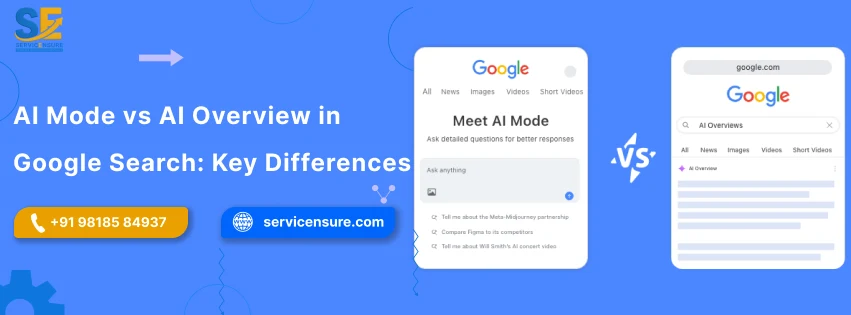
AI mode vs AI overview in Google Search is one of the most common areas that many businesses find difficult to understand. While both these AI models are significantly different from one another, many businesses, especially small-scale and startups, consider them synonyms. Although both models are from Google, their results and sources can differ from one another. This makes the questions arise, “Which one is better and which one to optimize for?” In this article, we will answer these questions by thoroughly discussing the differences between the two AI models of Google.
What Is Google AI Mode?
AI mode is a direct model from Google, and is designed to provide direct and easy-to-understand answers to even the most complex of queries. However, this mode is not an entirely different model, it is built on AI overviews and gathers the information from traditional search results. Due to it being an AI model, it does not provide a list of blue links. Instead, it synthesizes the information and provides direct answers. Although the interface looks similar to the AI overview, it provides the option to ask follow-up questions.
What Are The Key Features of Google AI Mode?
Google AI mode completely transforms the search into a conversational experience. To help you better understand how this conversational process takes place, we have shared the key features of the Google AI mode.
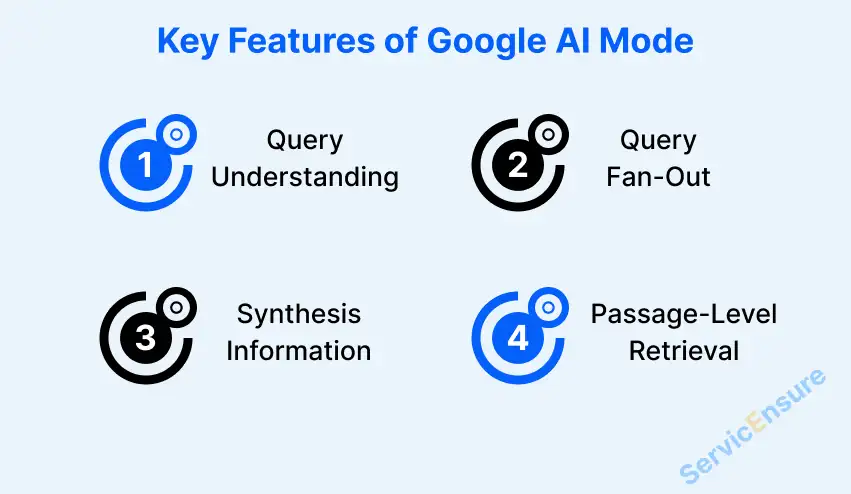
- Query Understanding: Google AI mode uses LLM (Large Language Models) to understand the intent behind the user’s query. Due to it using LLM, it can easily and quickly interpret direct questions and even complex topics.
- Query Fan-Out: This helps the model to divide complex prompts into smaller subtopics. Even though the prompt is divided, it executes them simultaneously and gathers information from relevant and credible sources.
- Synthesis Information: RAG (Retrieval-Augmented Generation) is one of the key features of Google AI mode, which it uses to retrieve external and up-to-date information. This information is then fed to LLM to generate summarized answers.
- Passage-Level Retrieval: Rather than scanning the entire page content, the model only scans specific sections to create relevant and direct answers.
What Is Google AI Overview?
AI overview uses generative AI to quickly answer queries. While both these models sound the same, what makes them different is that the AI model is actually conversational, while the AI overview is a single query-based model. Nonetheless, both these models synthesize information and provide direct answers rather than providing a list of blue links.
Contact us today and discover the best SEO services at the best prices.
How Does Google AI Overview Work?
Formerly referred to as Search Generative Experience (SGE), the Google AI overview runs on four key models to provide direct, synthesized answers to specific queries. Below, we have listed its core models to help you better understand how the AI overview of Google works.
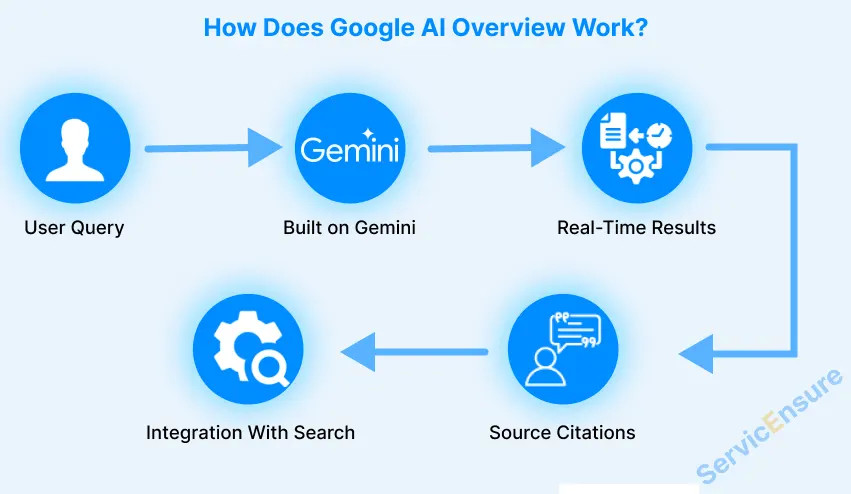
- Built on Gemini: The AI overview is not a standalone model. Instead, it is built on the features of Google’s Gemini. It also uses a Large Language Model for better reasoning and synthesis of answers.
- Real-Time Results: The AI overview generates results in real-time by pulling content from live sources, not just pre-trained data.
- Source Citations: AI overview provides direct citations in the results. Therefore, allowing users to explore the content for more detailed information.
- Integration With Search: The results from AI overviews appear directly on the top of search results of Google.
Also Read: How To Rank In Google AI Overviews: 7 Proven Tricks
AI Mode vs AI Overview In Google Search: What’s The Difference?
Speaking particularly of the Google AI mode, it is designed for exploration. This mode has signaled a shift from one-off queries towards a more conversational search experience. The primary difference between AI mode and AI overviews is that the AI mode can handle much more complex queries, refine the intent, and allows the user to naturally follow up the conversation without having to start a new search.
Query Fan-Out is a key mechanism that the AI mode uses. This helps the model to divide complex prompts into smaller subtopics. Even though the prompt is divided, it executes them simultaneously and gathers information from relevant and credible sources. For example, if a user searches for the best running shoes, then the AI mode will automatically branch into cushioning, terrain, injury prevention, and brand comparison.
AI overview, on the other hand, is designed to answer queries quickly and efficiently. These overviews are most common for broad, explanatory questions, also often referred to as long-tail keywords. The AI overview gathers information from multiple sources and presents it to the user. However, it does not just copy and paste the content. Instead, it rephrases and synthesizes the information through its generative models. One thing you need to understand about it is that it is a feature of Google Search powered by Google’s Gemini Large Language Model.
Understanding the difference between AI mode vs AI overview for search optimization is just as essential as implementing the practice itself. To help you better understand how AI mode and AI overview differ from one another, we have shared a thorough comparison below.
| Features | AI Mode | AI Overview |
| Goals | Deep exploration. | Fast summaries. |
| Length and form | Conversational and multi-step. | Short and synthesized. |
| Sources | Cites multiple pages. | Cites multiple pages. |
| User interaction | Allows for follow-up questions. | Minimal. |
| Clicks | Mixed. | Often reduces clicks. |
Also Read: The Most Important Google Ranking Factors in 2026
Why Did Google Introduce AI Mode?
While the AI mode has completely changed the game of how a business gains visibility, a common question still arises: “Why did Google introduce AI mode?” The short answer is that Google wants to transform the entire search experience from a list of links to a more interactive and conversational experience, which the AI overview does not provide. Mentioned below are some key reasons why Google introduced the AI model.
1. Handling Complex Queries
Users’ search queries have increasingly become more specific. Due to this, Google launched its AI model to better understand the query and provide direct answers. As a result of this, users do not need to open a page from SERP. Moreover, the AI model is also conversational, thus allowing the users to continue the conversation for deeper answers. This is a key difference between AI mode and AI overview.
2. Enhanced Productivity
One important aspect you need to understand about AI mode vs AI overview features comparison is that the AI mode does not only provide direct answers. Instead, it can also be used to compare options and even manage tasks. This makes it more of a personal assistant rather than a search results summarizer.
3. Improved Accuracy
One common problem with the user’s search experience was that they were required to jump from one page to another to find the right solution for their questions. Furthermore, Neil Patel’s guide stated that around 72% users were putting exact queries for what they wanted. This not only resulted in increasing the bounce time on websites, but also caused a poor search experience. Google fixed both these problems with its AI mode by summarizing and structuring it as accurately as possible.
How to Optimize Content For AI Mode vs AI Overview?
Even though both Google AI mode and AI overviews have significantly transformed the search experience, many businesses find it difficult to implement the changes in their practices. As a result, they proactively look for answers to “How to rank in AI mode vs AI overview.” While there is no doubt that these AI models have transformed search, it does not mean that they have made the entire practice of SEO redundant. On the contrary, SEO practices are the core foundation for optimizing to rank in both AI models, with only slight changes.
You can follow the practices we have shared below to ensure that your business is optimized for Google’s AI mode and AI overviews to appear in the relevant results.
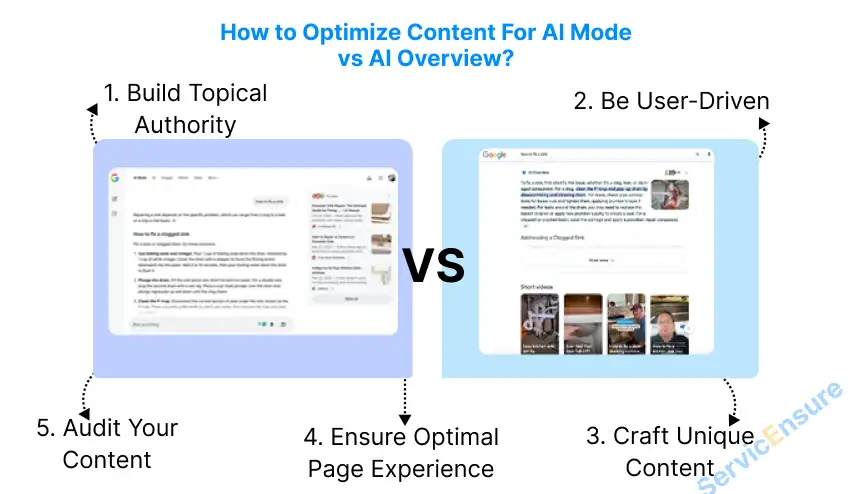
1. Build Topical Authority
Topical authority refers to establishing your business as a go-to expert within a specific niche. In order to do this, you will first need to thoroughly explore your main topic, then create cluster topics around it. Once you have done this, you will then need to link the topics with one another.
This will allow Google’s AI mode and AI overview to effectively scan your content and cite it. Building topical authority can take a considerable amount of time and effort and is not among the easiest steps. However, you can always reach out to ServicEnsure best digital marketing agency, for professional assistance.
2. Be User-Driven
The aim behind both Google’s AI models is to prioritize the user’s search experience. As a result of this, you will also need to create a user-centric approach. To start this approach, you will need to provide in-depth details in the content, all the while matching the search intent relevance. Also, make sure that your content is easy to understand and is structured properly to guide the user to the conclusion. This makes it one of the most reliable practices for AI mode vs AI overview for SEO.
3. Craft Unique Content
Crafting unique content does not just mean making it free of plagiarism. Businesses that believe unique content is equal to plagiarism-free content are the most common ones that find it difficult to understand how AI mode is different from AI overviews. Instead, this means delivering a unique value to the user that other results do not. This will result in signaling value to Google’s AI mode and will significantly improve the chances of the content ranking in AI mode results.
4. Ensure Optimal Page Experience
Even the highest quality of content will not get cited in Google’s AI mode if the page is slow to load or difficult to navigate. Therefore, you will need to ensure an optimal page experience across all devices. An optimal user experience signals reliability and credibility, which, in turn, will make it more likely to rank in Google AI mode. Moreover, this will also encourage users who come from SERP rankings to browse your website without closing the tab instantly.
5. Audit Your Content
Google timely launches algorithm updates, which affect both AI results as well as SERP rankings. In order to retain the position, you will need to audit the content. Moreover, specific updates in your industry may also cause the AI mode to cite other sources rather than yours. Therefore, you will need to ensure freshness and relevance in your content. However, auditing content is not a one-time task. Instead, it requires proactive monitoring and timely optimization. Investing in the best SEO services online can help you ensure this factor without raising any complexities.
Also Read: Google AI Mode Impact On SEO: Everything You Need To Know
How Google AI Mode and AI Overviews Impact SEO?
As the search results have shifted from prioritizing users’ search intent rather than matching exact keywords, it becomes essential to understand how Google AI mode impacts SEO, and how the AI overview has changed it. Mentioned below are the key areas where Google’s AI mode and AI overview have significantly impacted SEO.
- Declining organic traffic: Both these models provide direct answers to the user’s query. Due to AI mode vs AI overview impact on organic traffic, the user does not even need to open a single website. This has resulted in significantly declining CTRs to websites.
- Focus on Trust and Authority: These AI models rely heavily on the content from reputable sources. Due to this, businesses have shifted their focus from just targeting keywords to building trust and authority in the market.
- Structured Data: Schema markups have also become highly crucial as they help these AI models to better understand the information and present it in a relevant way.
- Conversational Keywords: Due to Google’s AI mode and AI overview, high-volume keywords provide little value compared to conversational keywords. These keywords are also often referred to as long-tail keywords and are highly specific queries that a user asks the search engine.
- Strategy: Although SEO is fundamental to appearing at the top of SERP, a top position is no longer enough to attract the targeted audience. Due to this, changes in the core strategy are required to rank well in Google’s AI mode as well as AI overviews.
Is Google AI Mode and AI Overviews the Future of Search?
The short answer to “Is Google AI mode the future of search?” is a yes. Google’s AI mode, along with the AI overview has transformed how users find answers to their queries. As both these models provide direct answers, above organic results, the whole process of browsing the blue links becomes almost redundant to the user. Although it is the future of search, it does not mean that traditional methods are out of the equation.
AEO (Answer Engine Optimization) practices have also become crucial for businesses of all scales and niches to effectively rise in the competitive market. With the updates of agentic commerce leaking in, AEO is expected to further evolve in the future. These changes will, without a doubt, set a new bar that businesses must meet in order to achieve visibility.
Aside from changing the search experience, the Google AI mode has also transformed significantly. Once it only used to understand keywords, now it can interpret highly specific and complex prompts. Moreover, it also provides detailed yet well-structured and accurate answers to the queries.

Leverage Google AI Models to Maximize Your Performance
Google AI mode and AI overview are not just limited to answering informational queries; they can interpret any type of intent. Moreover, despite the complexity of the prompt, they also provide clear and summarized answers. The AI mode also allows for follow-up conversations, a user can dig thoroughly into the topic without having to jump from one website to another. Due to these advancements, it becomes highly crucial to understand AI Mode vs AI overview. With a proper understanding of these models and successfully implementing the strategies, you can ensure that your business gets cited in their content and the targeted audience comes automatically to your website.
FAQs
Is Google AI mode and AI overview free?
Yes, both AI models of Google are completely free for all Google personal accounts. It instantly provides AI-generated summaries and assistance to even the most complex of prompts.
How do I activate Google AI mode?
In order to activate the Google AI mode, you will first need to type “Google AI mode” in the search bar. Then, open the official AI mode link by Google. Although you can use this mode just as it is, you can also sign in with your Google email for a more personalized experience.
Is Google AI mode better than Google AI overviews?
Yes, the Google AI mode is generally considered to be the better option than AI overviews. This is because the AI mode is capable of answering more complex queries, all the while allowing the user to engage in conversation with the AI mode.
What is Google AI mode used for?
The Google AI mode is used for more advanced, conversational searches to answer complex and multi-part queries.
Is Google AI mode better than ChatGPT?
Neither of them is inherently “better” when compared to the other. This is because both AI models excel in different areas. Therefore, the choice of “better” depends entirely on your requirements for the AI model.

Ved is a skilled Digital Marketing Expert known for building data-driven strategies that boost brand visibility and lead generation. With hands-on experience in SEO, PPC, and content marketing, he helps businesses scale their online presence and achieve measurable growth. His analytical approach and constant learning mindset make him a go-to expert for modern marketing challenges.