How to rank in Google AI overviews has become a common question as Google’s AI overview gathers information from multiple websites and summarizes them above the search results. This means that even if your articles are ranking at the top position, they may not attract users, as AI overviews will provide direct answers to their queries. However, AI overviews do not just randomly gather the information. Instead, it follows several guidelines when selecting the content. In this article, we will introduce you to proven tactics that you can use to make your content appear in AIO and achieve sustainable growth in the competitive market.
What Are AI Overviews In Google?
Google AI Overviews, also referred to as AIO, are AI-generated summaries that appear before organic search results. As these summaries provide direct answers to the users’ queries, they do not even need to open a single result page. However, Google AI Overviews do not create answers by themselves; instead, they gather information from multiple pages to generate answers. It also provides proper citations to the pages it used to gather information.
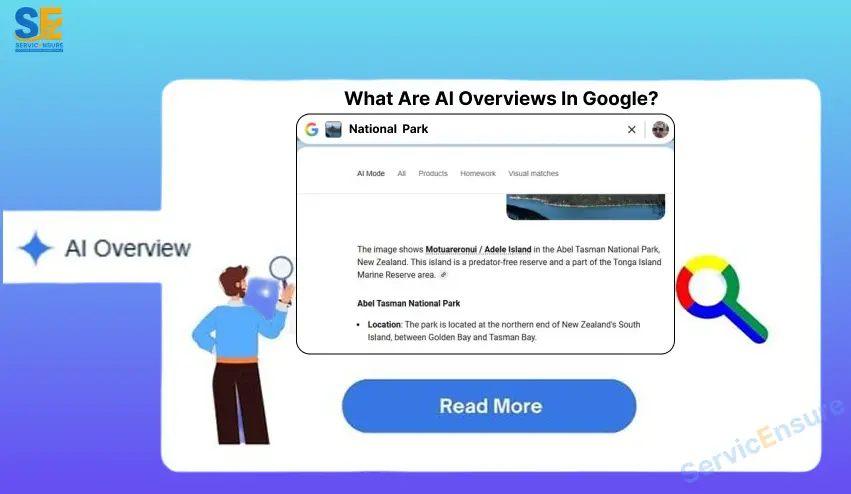
While the process may sound complex, it is actually rather straightforward. Below, we have listed some key pointers to help you better understand what are AI overviews in Google.
- It provides short and concise answers to the user’s query.
- It gathers the information from multiple relevant and reliable sources.
- It provides proper citations for the sources it used to gather information.
How Does Google AI Overviews Work?
Google AI overview runs on Google’s Gemini AI model. This model analyzes search queries, scans sources, and provides synthesized answers. Through this, it provides direct answers to complex topics, all the while providing citations to save users’ time. To help you better understand the process of how does Google AI overviews work, we have shared its key steps below.
- Understanding Query Intent: Rather than just matching keywords, the AI model understands the intent behind the user’s search query.
- Information Gathering: The system uses a modern technique called “Query Fan-Out,” which breaks complex topics into sub-sections for easier scanning.
- Summarization: When the content has been scanned, the model synthesizes the information to create neutral and easy-to-understand answers.
- Citation: Each AI overview includes clickable links to the sources. This allows the user to verify the information if needed.
Also Read: 7 Proven Ways On How To Increase Organic Traffic On Website
How To Rank In Google AI Overviews?
Now that you understand what are AI Overviews in Google and how they work, let’s discuss the top practices you can use to rank in these results. However, one thing you need to understand is that ranking in AI Overviews is an organic practice and is unlikely to provide results overnight. Instead, you can improve your chances of ranking over time by following these practices.
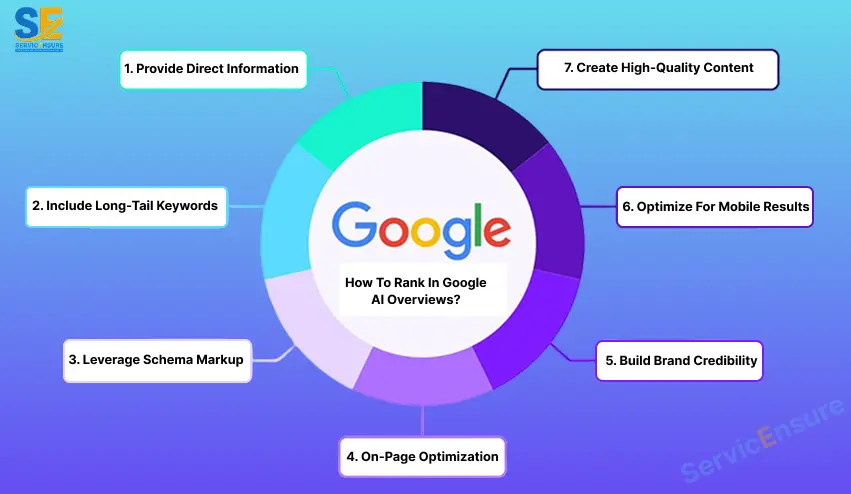
1. Provide Direct Information
One of the best strategies to rank in Google AI Overviews is to provide direct information. This is because Google prioritizes content that is well-contextualized and easy to understand. By sharing direct answers to the user’s query, you can ensure both these factors. One thing you need to understand here is that 99.9% AIO results are triggered by informational intent keywords. Therefore, if your article is on an informational keyword, then make sure that it is simple to understand with enough context to completely answer the user’s query.
Mentioned below are some key tips for how to optimize content for Google AI Overviews.
- Do proper keyword research to find AIO-triggering keywords, and use them naturally throughout the content.
- Make sure that your content fully answers the question behind the user’s query.
- Include queries from “People Also Ask” that are relevant to your topic.
2. Include Long-Tail Keywords
Rather than generic or short keywords, AI Overviews are most likely to be triggered by specific long-tail keywords. This is because long-tail keywords often align closely with the user’s search intent. Therefore, naturally include relevant long-tail keywords in your content to improve the chances of being cited in AIOs.
In order to do this, you will need to implement the following techniques.
- Use tools like AnswerThePublic to identify conversational keywords.
- Structure your content to provide immediate answers to such queries. Later, you can provide elaborated information in the article.
- Include long-tail keywords in your headings and sub-headings.
While long-tail keywords provide great benefits for AIOs, they can be rather difficult to use them. However, you can always reach out to the best SEO agency for professional assistance.
3. Leverage Schema Markup
Schema markups help search engines understand the context and structure of the content. By effectively using schema markup on your pages, you can help the search engine accurately interpret your content. This, in turn, will improve the chances of your content being cited in AI Overviews.
Mentioned below are some key schema markup types that you can use for how to optimize website for AI search.
- FAQ Schema: This helps Google identify question-answer pairs.
- Article Schema: This schema provides context about the article’s content, author, as well as the publication date.
- Breadcrumb Schema: This helps AI to understand the site hierarchy and navigation. As a result of this, AI can effectively browse the site to locate and cite relevant content.
4. On-Page Optimization
On-page SEO still remains to be the foundation for both traditional SERP as well as AI Overview rankings. The majority of results in AI Overviews come from the top 10 results on the first page. This means that by ranking your page at the top of the results, you can significantly improve the chances of your content being cited in AIOs. If you would like assistance with optimizing your website for on-page, feel free to reach out to ServicEnsure digital marketing company.
The best practices for optimizing on-page include:
- Use keywords naturally throughout the content and include the primary keyword in the main title.
- Writing compelling meta descriptions as well as meta titles.
- Ensuring that the content adheres to E-E-A-T guidelines.
5. Build Brand Credibility
Credibility is one of the most essential factors for how to rank in Google AI Overviews. This is because a high credibility signal authoritativeness and trust to the search engines. As a result, the chances of being cited in AIOs improve drastically. In addition to this, a higher credibility will also assist in effectively attracting the targeted audience and promoting relationships with them.
Mentioned below are some key steps that you can follow to promote the credibility of your business.
- Engage in digital PR to gain mentions from other reputable businesses in the same niche.
- Proactively monitor your brand mentions to ensure positive associations.
- Create comprehensive topic clusters rather than single, isolated posts.

6. Optimize For Mobile Results
The majority of searches on Google are done through mobile devices. Due to this, Google also prioritizes websites that are optimized for mobile results. Optimizing the entire website for mobile results is one of the best strategies to rank in Google AI Overviews, along with achieving a higher position in organic search results.
You can follow the tips we have shared below to optimize your website for mobile results.
- Use mobile-responsive designs to ensure optimal content display.
- Make sure that the entire content of your website quickly loads for mobile users.
- Ensure easy navigation.
7. Create High-Quality Content
When it comes to answering how to rank in Google AI Overviews, ensuring optimal content quality is undoubtedly the most essential aspect. High-quality content makes your entire business appear credible and trustworthy. Therefore, you will need to ensure that your content provides a unique value that cannot be found on other results. Moreover, Princeton University and the Indian Institute of Technology Delhi also found that citing reputable sources can further improve the chances of the content ranking in AI Overviews.
You will need to ensure the following factors to make your content higher quality than that of your competitors.
- Provide descriptive headings to help both users and Google easily understand the context.
- Make use of bullet points to break down complex information.
- Regularly update your content to make it relevant to the market changes.
Also Read: Google AI Mode Impact On SEO: Everything You Need To Know
AIO vs SEO: Which One Is Better?
SEO has long been the holy grail of digital success, but since AI entered the market, the practices of SEO have seen significant changes. Nowadays, search engines, like Google, do not just match exact keywords. Instead, it uses advanced algorithms to understand the intent behind the search query. However, this does not mean that the entire practice of SEO has become redundant. On the contrary, SEO practices have also evolved to provide better results to the user. To help you better understand the differences between AIO and SEO, we have shared a comparison table below.
| Aspects | AIO (AI Overviews) | SEO (Search Engine Optimization) |
| Primary goal | Get content cited, summarized, or recommended by AI systems. | Rank webpages higher in search engine results pages (SERPs). |
| Target platforms | AI assistants and generative engines such as ChatGPT, Google Gemini, and Perplexity AI. | Search engines like Google, Bing, and Yahoo. |
| Focus | Contextual clarity, entity authority, structured knowledge, and semantic depth. | Keywords, backlinks, technical optimization, and user experience. |
| Content style | Clear, authoritative, structured, fact-based, citation-ready. | Keyword-optimized, engaging, and competitive against other ranking pages. |
| Ranking factor | AI understanding, entity relationships, structured data, credibility. | Algorithms based on relevance, backlinks, page speed, Core Web Vitals, etc. |
| Traffic outcome | May reduce direct clicks but increase brand visibility in AI answers. | Drives organic traffic via clickable search results. |
| Measurement metrics | AI citations, brand mentions in AI responses, and share of AI answers. | Organic rankings, click-through rate (CTR), impressions, conversions. |
| Optimization techniques | Schema markup, entity building, topical authority, FAQ clarity, conversational formatting. | On-page SEO, off-page SEO, technical SEO, and link building. |
| Content discovery model | AI-generated summaries and direct answers. | Ranked list of blue links and featured snippets. |
Contact us today and discover modern SEO strategies for your business success.
Enhance Your Business Discovery With AI Overviews
Due to AI Overviews, the process of how a user discovers the content and engages with a business has completely changed. Now, most users do not even check the top three results as they directly get the answers to their queries at the very top of the search result page, in AI Overviews. Due to such changes, many businesses, especially small-scale and startups, have asked how to rank in Google AI Overviews. Although the tips we have shared can help you rank in AIOs, do note that you will need to continuously monitor your position and optimize the content to get the best possible results.
FAQs
What does the Google AI Overview do?
Google AI Overviews provide users with direct answers to their queries without requiring them to search a single result.
Is ChatGPT an AI Overview?
No, ChatGPT is not an AI Overview, but a conversational AI mode. AI Overviews only provide direct answers to a specific, individual query rather than follow-up questions.
Can AIO replace SEO?
No, AIO cannot replace SEO, as it does not generate the answers by itself but relies on online results. It analyzes the online results and provides summarized answers with proper citations.
Are AI Overviews accurate?
Although AI Overviews are reliable, they are not 100% accurate. However, Google is actively conducting extensive tests to enhance the accuracy.
Where do AI Overviews get the information from?
AI Overviews gathers information from multiple credible sources, like top-ranking websites, high authority websites, recent content, and content that is relevant to the search intent.

Ved is a skilled Digital Marketing Expert known for building data-driven strategies that boost brand visibility and lead generation. With hands-on experience in SEO, PPC, and content marketing, he helps businesses scale their online presence and achieve measurable growth. His analytical approach and constant learning mindset make him a go-to expert for modern marketing challenges.