
Google ranking factors in 2026 have changed significantly. Rather than matching exact keywords, the search engine now prioritizes content that shares in-depth details and is relevant to the search intent. Businesses that neglect the new ranking factors are not able to rise in the competitive market. Furthermore, old practices, like keyword stuffing, can also result in getting penalized. To help ensure that you are able to secure top positions for business in online rankings, we will discuss the most important ranking factors of Google, along with their best practices.
What Are The Important Google Ranking Factors?
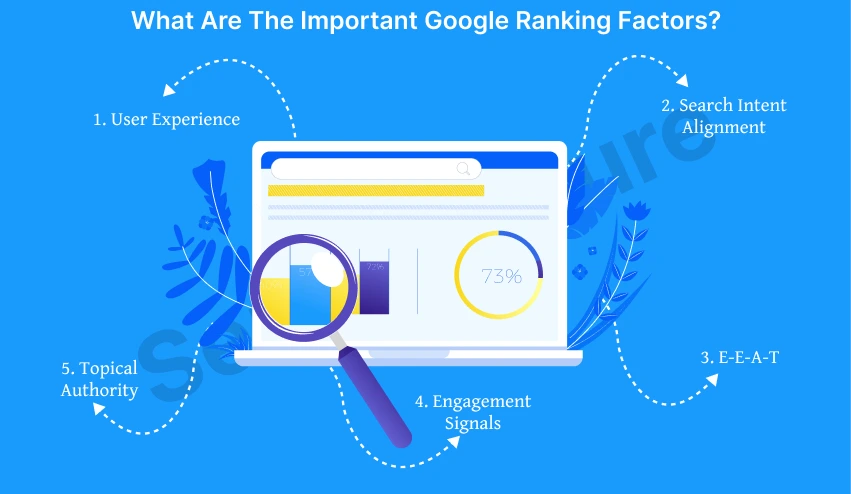
Google aims to provide the best and most relevant results to its users. Due to this, it often filters out outdated or keyword-stuffed content. Google uses multiple ranking factors to determine which content should appear at the top of the results. Below, we have shared some of the most important Google ranking factors.
1. User Experience
User experience is one of the most important SEO ranking factors. Google’s systems are able to assess how a user interacts with an individual website and its pages. It uses this information to understand whether the site has optimal loading speed, a clean interface, and a mobile-friendly layout. If a website has an optimal user experience, then Google will favor it over websites that don’t.
2. Search Intent Alignment
Google no longer prioritizes content that matches the exact phrases from a search query. Instead, it aims to understand the meaning behind those queries and provide results that best answer them. While it is among the top Google ranking algorithms, it goes far beyond a single broad label. This is because it is divided into four different categories, each of which aims to attract audiences from different stages of the marketing funnel. The four types of search intent are:
- Informational: It includes users who are looking for answers, tips, or perhaps guides.
- Navigational: The user is trying to navigate to a specific website or a page.
- Commercial: Users of this intent are planning to make a purchase but are not yet fully ready.
- Transactional: This intent indicates that users are ready to make a purchase.
3. E-E-A-T
E-E-A-T (Expertise, Experience, Authoritativeness, and Trustworthiness) continues to be one of the driving ranking factors. While E-E-A-T is not exactly a part of the algorithm, it is one of the most important Google SEO guidelines. Adhering to E-E-A-T guidelines can also help ensure both relevance and engagement. Higher relevance contributes to building authority over time. Google also analyzes E-E-A-T factors to identify whether the website is properly following the guidelines. Websites that do not adhere to these guidelines will find it difficult to rank well, while the ones that do follow E-E-A-T guidelines will thrive inevitably.
Also Read: What is E-E-A-T and Why Is It Important for SEO?
4. Engagement Signals
When it comes to improving online rankings, engagement signals play a crucial role. These engagement signals include click-through rates, dwell time, scroll depth, and repeat visits. Google assesses these signals to determine whether the content is actually helpful or not. Based on this analysis, Google ranks the content on the SERP (Search Engine Results Page).
5. Topical Authority
In 2026, Google page ranking algorithms are increasingly favoring websites that demonstrate clear topical authority. In simple terms, topical authority is a SEO jargon for subject matter expertise. Contrary to domain authority, topical authority is the perceived authority that is built over a niche or a broader subject. According to Niel Patel’s guide, AI tools like ChatGPT and Perplexity also use this to determine whether the content should be shown to the user or not.

Best Practices to Improve Your Google Search Ranking
While there are multiple ways to improve your Google search ranking organically, one thing you need to understand is that ranking does not improve overnight. Moreover, continuous monitoring and optimization are also required to ensure optimal results. Below, we have listed some key practices that you can follow to attain a higher position in search engine rankings.

1. Craft Unique Content
Avoiding duplicity is one of the primary rules of content writing. When it comes to crafting unique content, however, it means that the content should provide a unique value to the user. The content should provide in-depth information on the topic. Moreover, a catchy title tag will also contribute significantly to attracting potential customers.
Although crafting multiple unique content can be tricky, especially if you are an eCommerce site owner, you can always take the assistance of organic search engine optimization services to craft high-quality as well as unique content.
2. Improve User Experience
User experience is one of the most essential factors for website optimization for Google. A poor UX will result in causing your audience to quickly leave your website. If enough people bounce from your website back to search engine results, then this signals Google that your results didn’t provide the users with the answers they were looking for. As a result, your site ranking will drop along with organic traffic.
In order to avoid this scenario from coming true, you will need to optimize scenarios, like.
- Loading Speed: Reduce the size of images and use browser caching to improve the overall speed of your website.
- Mobile-Friendly Design: Make sure that your website is fully functional and easy to use on mobile devices.
- Clear Navigation: Create a clear and hierarchical navigation structure so that your users can quickly find information.
- White Space: Prevent overcrowding of sections by effectively using whitespace. This will make the design clean, organized, and easy to understand.
- Accessibility: Ensure that your content is easy to understand and provides clear information.
3. Optimize Visuals for SEO
Visuals play a significant role in engaging users with the content and informing them about the product, service, or the entire business. However, visuals need to be optimized with clear names and alt text. This is because the crawlers cannot analyze visuals, and they use visual’s name and alt text to determine the content of the visual.
Therefore, no matter how appealing your visuals may be, they are highly unlikely to come in the top results if they are not optimized. Speaking of optimising visuals, you will also need to ensure that the visuals are clear while being small in size. This will ensure that the visuals load quickly and the user does not leave your website instantly.
4. Add Schema Markup
One of the most renowned SEO optimization tips is adding schema markup. Schema markup helps search engines better understand what the content of your website is about. This not only helps to improve visibility but also results in improving overall engagement. However, in order to get these benefits, you will need to add the right schema type for specific content formats.
The different types of schema include:
- Article Schema: This schema markup type is specifically for blog posts, news articles, or other written content on your website.
- FAQ Schema: As the name suggests, this schema markup is for presenting frequently asked questions in an organized as well as search-optimized way.
- Event Schema: This is ideal for highlighting event dates, locations, and ticketing details that you shared on your website.
- LocalBusiness Schema: This schema markup is specifically for local businesses as it includes address, working hours, and contact information to boost visibility and attract local customers.
Adding the right type of schema markup is one of the ideal ways to optimize your website for search engines. Furthermore, it will also help your content to stand out with rich snippets, promoting both organic visibility and click-through rates (CTR).
Also Read: How To Add Schema Markup To Improve SEO Performance?
5. Build High Quality Backlinks
Backlinks are a core part of almost every SEO strategy. While backlinks do not directly impact content, they act as a “vote of trust” by earning links from other credible and trustworthy websites within the same niche. One important factor about building backlinks to understand is that the practice is a marathon, not a sprint. Therefore, high-quality backlinks provide much more significant value than those low in quality. Due to this, make sure that your backlink profile only contains optimal quality backlinks. Low-quality backlinks might not even provide any reliable results, not to mention that they often run along with the risk of getting penalized.
Leverage Google Ranking Factors to Hold Top Results
In 2026, Google ranking factors have changed significantly and no longer prioritize results by matching exact phrases. Instead, the ranking is determined by relevance, user satisfaction, authority, and engagement. Google uses multiple metrics and guidelines to rank content. By thoroughly understanding these factors and implementing their relevant practices, you can ensure that your business rises effectively in the online market. However, one crucial thing to understand is that organic ranking may drop overnight; it will not rise in the same duration. Therefore, regular monitoring and optimization become important.
FAQs
What are the main pillars of SEO?
There are four main pillars of SEO: On-Page SEO, Off-Page SEO, Technical SEO, and Content Quality. When working together, these pillars will improve a website’s organic visibility and traffic.
Are backlinks in SEO still important?
Yes, backlinks in SEO still remain a significant ranking factor. However, their value is not the same as it was a few years ago. Google now looks for links that are authoritative, relevant, and trustworthy.
What should businesses focus on to improve Google page rank?
The most important ranking factors that a business should focus on are user experience, search intent alignment, E-E-A-T, engagement signals, and topical authority.
Why do search rankings change so frequently?
Organic rankings fluctuate because Google frequently launches algorithm updates. Algorithm updates introduce new guidelines or update the previous ones. This causes significant organic ranking shifts. However, by adhering to the guidelines and implementing the changes, you can retain the position in search results.
What is the golden rule of SEO?
The golden rule of SEO means creating content for users rather than search engines. This means providing clear, relevant, and engaging information to the audience.

Aadiv Atharv is a results-focused Digital Marketing Specialist with expertise in performance marketing, social media strategy, and conversion optimization. He excels at crafting creative, ROI-oriented campaigns that help brands connect with the right audience. His blend of creativity and technical skill makes him a powerful force in today’s competitive digital landscape.