
On February 5, 2026, Google’s Discover Core update was launched. Similar to previous Google Core updates, the February entry has also significantly influenced the market. Googly’s February 2026 Discover Core update was not just a minor background adjustment. Instead, it is a major paradigm shift in how Google determines what comes at the top of the results. This update has significantly influenced businesses of all scales and niches, and many are still struggling to adjust their strategies according to it. In this article, we will provide you with a complete breakdown of Google’s Discovery Core update and how you can use it to effectively rise in the competitive market.
What Is The Google’s February 2026 Discover Core Update?
The question of “What is the February 2026 Discover Core update?” is central to understanding how content visibility is evolving beyond traditional search. This update is a major and broader-level adjustment that directly and specifically targets content in Google’s Discover feed. The main aim behind this update is to help improve how content is selected, prioritized, and presented in users’ feeds.
However, unlike ranking-focused updates, like Google’s Search Core update, the Discovery update completely revolves around the recommendation quality. Due to Google’s February 2026 Discover Core update, the system places much stronger emphasis on relevance, originality, as well as real user value. This means that keyword positions are no longer the driving factor behind making content appear in users’ discovery feeds.
What Google Changed in the Discover Guidelines?
With the latest installment in the Discover updates, Google’s Discover has become more selective, rewarding originality, credibility, as well as promoting user engagement, all the while filtering out low-quality content. Despite this, many businesses are still asking, “What Google changed in the Discover Guidelines?” Google highlights three specific areas where Discover’s content surfacing systems are being improved.
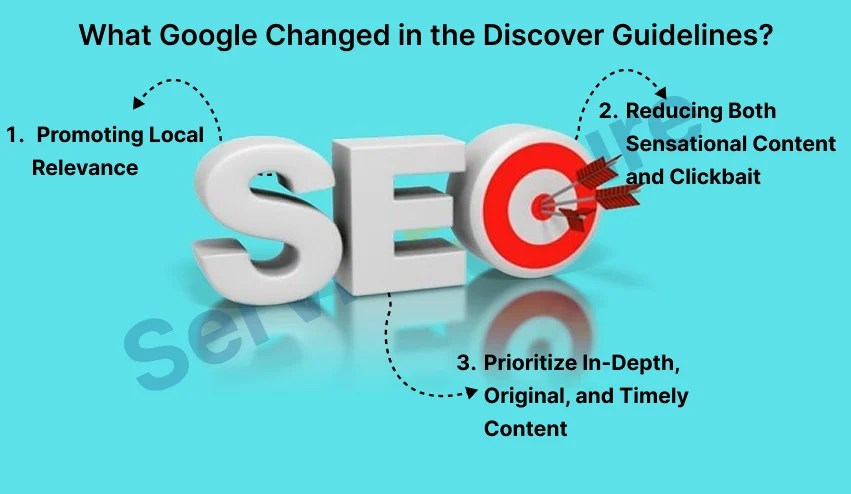
1. Promoting Local Relevance
One of the major focuses of this update is promoting local relevance. In the Discover update guidelines, Google clearly states that the Discover feed will show users more content from websites that are based in their own country. To break this down for easier explanation, this reflects a stronger preference for sources that are geographically closer to the audience.
This change signals that the Discover update is emphasizing:
- Where the publisher is located.
- Whether the content successfully reflects local context, concerns, or perspectives or not.
- How relevant is the content to the user in a specific country or region?
2. Reducing Both Sensational Content and Clickbait
Another clear goal of this update is to reduce the presence of both sensational and clickbait content in the Discover feed. Google also explicitly calls out both exaggerated headlines as well as sensational packaging as areas to prioritize.
However, this does not mean that the content should be dull or unengaging. Instead, this guideline means that:
- Headlines should clearly reflect what the article or blog is about to deliver.
- Emotional manipulation and curiosity gaps are to be deprioritized.
- Both trust and clarity signals should be prioritized.
3. Prioritize In-Depth, Original, and Timely Content
The third area of improvement focuses on the content quality, as it is tied to the expertise within a specific subject. Now, the Discover system aims to promote content from publishers that demonstrate real understanding and sustained coverage of a topic rather than generic content.
As per Google’s February 2026 Discover Core update, it will favor content that is:
- Covers relevant topics in-depth.
- Original in either perspective or information.
- Timely and well-maintained.

Why These Discover Guideline Changes Matter?
Understanding why these Discover guideline changes matter is highly crucial for all businesses that rely on organic visibility. This update has clearly signaled a fundamental shift in how content is surfaced. Rather than simply matching queries, Discover evaluates whether the content aligns with the user’s interests, browsing behavior, and engagement history.
To explain this change in simple terms, content is no longer rewarded for volume or frequency alone. Instead, Discover now prioritizes value over volume. This means that content should be of optimal depth, originality, and relevance. From a long-term perspective, these changes significantly impact both content strategy as well as brand trust. Over time, this will result in improving visibility and helping websites become more recognized sources rather than one-time traffic spikes.
The traffic implications for marketers and businesses following recent Discover changes are both significant and complex. Unlike traditional search traffic, Discover traffic can be highly dynamic as it is driven by user interests rather than active queries. One of the most noticeable effects is increased volatility.
Who Was Most Affected By The Update?
While Discover now distinguishes between low-value and high-value content more effectively, it is also highly crucial to understand who was most affected by the update. The update clearly divides websites that rely on volume and tactics from those that invest in expertise, originality, and trust.
To help you better understand this, we have shared a comparison table between sites that saw traffic declines and sites that benefited from Google’s February 2026 Discover Core update.
| Sites That Saw Traffic Declines | Sites That Benefited |
| Thin or shallow content with limited depth. | In-depth and experience-driven content. |
| Rephrased or lightly written content | Original insights and firsthand expertise. |
| Clickbait-driven Discover headlines. | Honest and value-focused titles. |
| High publishing volume with low value. | Quality-first, selective publishing. |
| Weak or missing author attribution. | Strong author bios and transparency. |
| Overreliance on trends without substance. | Balanced mix of timely and evergreen content. |
| Generic or stock visuals. | Unique and high-quality custom visuals. |
| Short-term Discover traffic focus. | Long-term authority and brand trust. |
In order to effectively navigate through the changes that came from this update, you can partner with a reliable ServicEnsure digital marketing company to refine your strategies, make Discover-focused optimization, and manage traffic volatility. Furthermore, their strategic guidance will also help you balance timely content with long-term authority building.
Best Practices to Win in Google Discover After the Update
In order to adapt to the latest Discover changes, changing strategies will be required. The best practices to win in Google Discover after the update revolve around building long-term value rather than chasing short-term visibility. Below, we have shared some key practices that can help you stand out from the competition and appear at the top of the Discovery feeds of your targeted audiences.
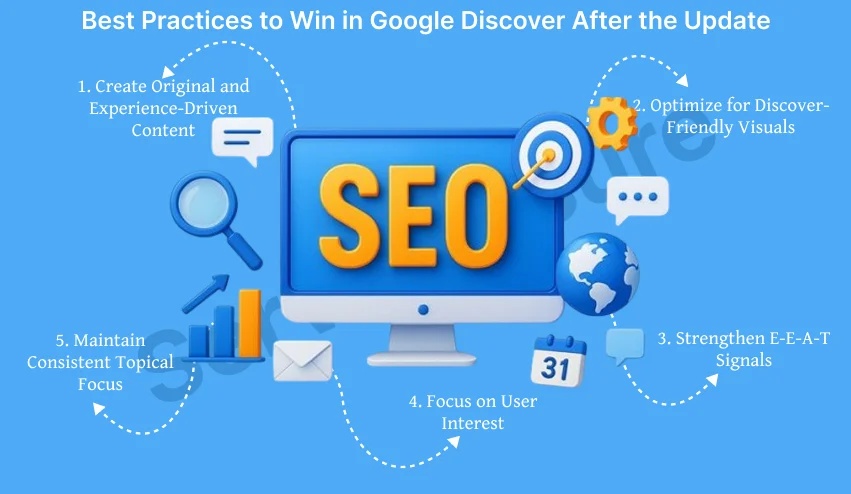
1. Create Original and Experience-Driven Content
Discover gives much preference to content that is based on first-hand experience and opinion. Those articles that indicate genuine experience, like testing, use, observation, or opinion of experts, are more distinctive than generic summary articles.
The best practices for this include:
- Post about personal experiences, case studies, or commentary.
- Make contributions that are not available elsewhere.
- Do not repackage trending topics.
- Focus on depth rather than length alone.
2. Optimize for Discover-Friendly Visuals
Images are very important in Discover visibility. Moreover, images can also help encourage users to engage with your content. As a result of optimizing for Discover-friendly visuals, you can improve click-through rates, all the while signaling quality to the algorithm.
In order to do this, you can follow the practices we have listed below.
- Use clear images with a high resolution that can be viewed on mobile.
- Keep the aspect ratios in order to prevent the problem of cropping.
- Prepare strong thumbnails conveying content in an honest manner.
- Use original pictures instead of stock pictures.
3. Strengthen E-E-A-T Signals
E-E-A-T (Experience, Expertise, Authoritativeness, and Trustworthiness) has long been a central factor in Discover’s success. These signals can help Discover to identify your content as reliable rather than just repeated. Moreover, these signals will also contribute significantly to improving transparency and credibility over time.
You can follow the listed below practices to strengthen E-E-A-T signals for your website.
- Showcase author bios while highlighting their expertise.
- Make sure that your website has a clear About Us page.
- Link author profiles to pages and posts where relevant.
- Ensure consistent publishing standards across your site.
4. Focus on User Interest
In order to rise in the Discover feed, you need to focus on users’ interests rather than just keywords. This is essential because Discover analyzes and responds to user interest patterns as well as engagement signals. In addition to this, you will also need to ensure that your content is of the relevant search intent.
To ensure that your content is user-focused, you can implement the following practices.
- Create trend-based content that is relevant to both your niche as well as current user interests.
- Track Discover performance in order to know what audiences want.
- Write your content naturally without forcing keywords into headlines.
- Timely update your content.
5. Maintain Consistent Topical Focus
Google’s Discover highly favors websites that showcase clear expertise within a niche. This means that instead of writing content on multiple, unrelated topics, focus on writing detailed content that is central to your niche. This will help you create a strong topical identity, which, in turn, will promote your content on the Discover feed.
- Only write content that is relevant to your niche.
- Develop content clusters around the core theme of your business.
- Avoid published off-topic content for short-term traffic.
- Ensure that your content is adhering to E-E-A-T guidelines.
Don’t lose traffic to algorithm changes — Contact us and get expert SEO solutions tailored for your business.
Prepare Your Content Strategy for the Discover-First Era
The shift toward a Discover-first is a signal towards a broader change in how audiences find content and interact with it. Google’s February 2026 Discover Core update reinforces the importance of creating content that aligns with user interests, trust, and long-term relevance rather than short-term tactics. This implies that as a marketer, publisher, and business, the content strategy needs to be thought of in a more discovery-friendly manner, focusing not on visibility but on audience connection.
FAQs
Is Google Discover different from search?
Yes, Google Discover is different from search, as the content appears directly on the user’s Discover feed without requiring them to type in a single keyword.
Does Google’s February 2026 Discover Core update affect search rankings?
No, Google’s February 2026 Discover Core update does not affect search, as the update primarily impacts content visibility on Discover feeds.
Why is Discover traffic so unstable?
The Discover traffic is heavily influenced by user interests, engagement behavior, and content freshness. Due to these factors, the traffic of Discover is more volatile than traditional organic search traffic.
How often does Google update its Discover algorithms?
Google’s Discover is updated continuously, with periodic core updates that refines how content is selected, personalized, and displayed to users.
Does publishing more content increase Discover traffic?
Yes, publishing more content can help increase Discover traffic, as it expands the areas of opportunities where content can align with users’ interests and their behaviors.

Ved is a skilled Digital Marketing Expert known for building data-driven strategies that boost brand visibility and lead generation. With hands-on experience in SEO, PPC, and content marketing, he helps businesses scale their online presence and achieve measurable growth. His analytical approach and constant learning mindset make him a go-to expert for modern marketing challenges.