
What is KPI in digital marketing might sound like just another buzzword, but it’s the backbone of every smart decision. A KPI, which stands for Key Performance Indicator, is a measurable value that shows whether your campaigns are actually helping the business grow. This means that instead of guessing what’s working, you can use KPI for clarity and direction.
The right KPI can help you transform raw data into revenue by showing you the exact data where you need to invest efforts and where you must not. But do you actually know what the right KPIs are? In this article, we will help you answer that question by discussing the top KPIs for digital marketing, why they matter, as well as the best ways to track them without getting overwhelmed by the numbers.
Why Are KPIs Essential For Your Marketing Plan?
For every digital marketing effort, whether it be improving a website ranking or running PPC advertisements, KPIs can help you differentiate between running a campaign and running a campaign that works. A marketing plan without KPIs is mostly guesswork, from spending money to launching ads. Even if your campaigns do work, you will have no method to further optimize them or even analyze the factors that were able to drive results.
With clearly defined KPIs, on the other hand, you get to focus on outcomes instead of activities, such as:
- Which channel is bringing in the highest ROI?
- Which ad is attracting the most amount of qualified leads?
- Which content is genuinely influencing the purchase decision of your audience?
In addition to this, KPIs can also help you bring alignment across your teams. This means that your teams will be moving towards the same business goals, instead of isolated metrics.
To explain the content of this section in short, KPIs can make your marketing plan sharper, smarter, and more profitable.
The 5 Best Digital Marketing KPIs
Now that we have talked about what is KPI in digital marketing, and why they are essential, let’s take a look at the different categories of KPIs. Before we do that, however, you first need to understand that the category of each KPI reflects a different stage of the customer’s journey. Understanding these buckets can help effectively evaluate the performance from the first interaction to the final purchase.
Listed below are the 5 best digital marketing KPIs.
1. Strategic KPIs
This is among the most important KPI for digital marketing as it provides a clear picture of the health of your company. Strategic KPIs are used to guide decision-making as well as connect all your business activities to help achieve a desired future state of your company. Instead of prioritizing short-term business results, these KPIs are used to create a long-term impact and efficacy of strategies.
2. Operational KPIs
Just like Strategic KPIs were used for long-term goals, Operational KPIs are used for short-term goals. These types of KPIs can be used to measure performance on a month-to-month or even a day-to-day business process in real-time. Some common examples of Operational KPIs include sales by production output, sales by region, inventory turnover, and customer service resolution time.
3. Functional KPIs
This category of KPIs is specific to different departments and functions. By using them, you can effectively measure metrics, such as:
- Efficiency of the customer service department.
- Performance of a marketing campaign.
- Sales team performance.
4. Leading and Lagging KPIs
Leading KPIs can be used to make predictions on future performance and identify potential problems as well as opportunities. Common examples of this category of KPI include customer satisfaction and employee engagement. Lagging KPIs, on the other hand, are used to measure past performance and gain crucial insights into what happened previously. A common example of Lagging KPIs can be the profit margin for a product.
5. Input and Output KPIs
The purpose of the Input KPIs is to measure the requirements of resources used to produce the desired results. Whereas Output KPIs measure the results that came from the resources. Furthermore, Output KPIs can also help you evaluate the effectiveness of your marketing efforts by measuring the results or outcomes you were able to achieve. This is also one of the essential KPIs that the best digital marketing company in Gurgaon adheres to.
How To Choose Digital Marketing Metrics and KPIs?
Picking the right KPIs for your business may seem like a complicated task, as there are multiple factors to consider, and not to mention a wrong selection of KPI can have a drastic negative impact. However, by following the 5 steps we have listed below, you will be able to choose the right digital marketing metrics and KPIs.
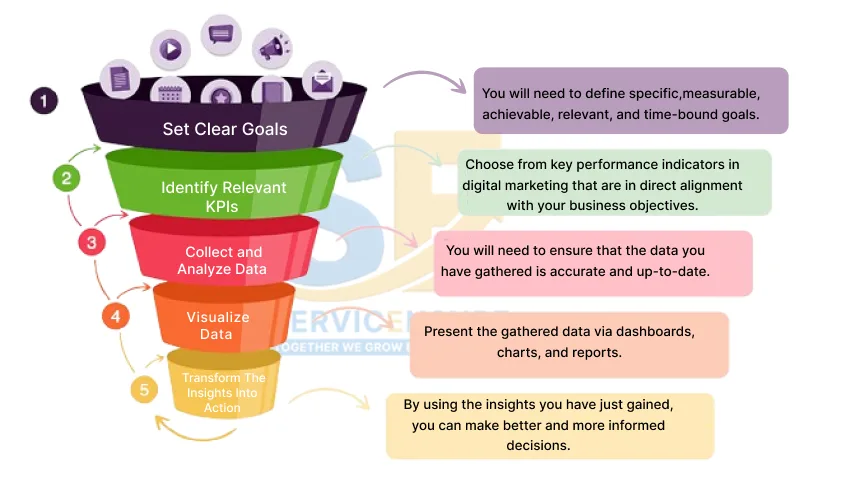
1. Set Clear Goals
In order to choose the right digital advertising KPIs, you will need to define specific, measurable, achievable, relevant, and time-bound goals. Below, we have listed some examples of what these goals can be.
- Improve brand awareness.
- Enhance operational efficiency.
- Generate quality leads.
- Strengthen customer support.
- Expand into new markets or locations.
Clearly defining your goals is essential, as it will dictate whether KPIs are measured effectively or not.
2. Identify Relevant KPIs
Choose from key performance indicators in digital marketing that are in direct alignment with your business objectives. By doing so, you will be able to ensure that the KPIs are providing meaningful insights into your performance.
3. Collect and Analyze Data
In this step, you will need to ensure that the data you have gathered is accurate and up-to-date. For this, we recommend that you use master data sources, such as website tracking and analytics, and CRM dashboards.
4. Visualize Data
You can present the gathered data via dashboards, charts, and reports. Through this presentation, you will be able to have a better understanding of this data and will be able to foster alignment between your teams.
5. Transform The Insights Into Action
By using the insights you have just gained, you can make better and more informed decisions. Moreover, you will also be able to take effective actions to improve the performance as well as the overall health of your business.

Common Mistakes to Avoid
With a proper understanding of what is KPI in digital marketing and by following the listed steps, you will be able to select the right performance indicators. However, there are a few factors that you need to consider in order to prevent any poor decisions for your business.
1. Tracking Vanity Metrics Instead of Performance Drivers
Your campaigns may generate a high amount of impressions, likes, and even followers, and still contribute to nothing when it comes to overall business growth. These numbers may look impressive, but they do not contribute to improving either revenue or conversion, thus giving them the title of vanity metrics. Therefore, you should treat these metrics as supporting indicators, and not as success measures.
2. Not Connecting KPIs To Revenue
You will need to ensure that all the leads you have generated are able to turn into paying customers or not. Leads without nurturing them into paying customers cannot help a business rise in the competitive market. Furthermore, this may also promote a false sense of success and waste budget.
In order to avoid this mistake, you can follow the steps we have listed below.
- Use KPIs to map the entire customer journey (from awareness to conversion).
- Track downstream metrics (from leads to MQL to SQL to customer to recurring revenue).
- Report performance on financial terms, not on just surface-level outcomes.
3. Ignoring Attribution Changes
Attribution changes refer to the modification of how the process of credit for a conversion is assigned to different marketing touchpoints throughout the customer’s journey. Due to the new privacy restriction laws, the use of cookies has changed significantly, and it is not an ideal choice to rely on traditional analytics. Speaking of traditional analytics, they cannot now provide you with a complete view of what is working and what is not.
In order to attain reliable insights, you can follow the metnioned below methods.
- Shift towards server-side tracking and modeled attribution.
- Make use of blended measurements. For example, combining analytics with backend revenue data + platform insights.
- Evaluate current and rising market trends instead of obsessing over 100% precision.
Also, check out our article on The Future of SEO With AI: What Has Changed?
Smart KPIs, Smarter Marketing
In addition to a thorough knowledge of what is KPI in digital marketing, you also need to understand that these indicators only matter when they lead to action. The biggest mistake most businesses make is that they chase numbers that look big, instead of focusing on numbers that can actually help their business. Therefore, choose KPIs that can help your business progress and guide decisions, instead of vanity metrics.
FAQs
What are KPIs in SEO?
KPIs in SEO are Key Performance Indicators that help to evaluate the effectiveness of your Search Engine Optimization strategy by tracking performance towards business goals.
What is the difference between a KPI and a metric?
A metric is used to track activities like an impression or a click. A KPI, on the other hand, can help you track the performance towards your business goal, for example, conversion rates or CAC (Customer Acquisition Cost).
What are the four Ps of KPIs?
The four Ps of KPIs include Product, Price, Place, and Promotion.
What are the important digital marketing KPIs I should track?
The important digital marketing KPIs you can track are Return on Investment (ROI), Customer Acquisition Cost (CAC), Conversion Rates, and Customer Lifetime Value (CLV).
How often should I review KPIs?
We recommend that you review your KPIs on a weekly basis, as it can help you quickly spot trends. However, if you are running paid campaigns, then daily monitoring is recommended as it can help you quickly adjust your budget.

Aadiv Atharv is a results-focused Digital Marketing Specialist with expertise in performance marketing, social media strategy, and conversion optimization. He excels at crafting creative, ROI-oriented campaigns that help brands connect with the right audience. His blend of creativity and technical skill makes him a powerful force in today’s competitive digital landscape.